
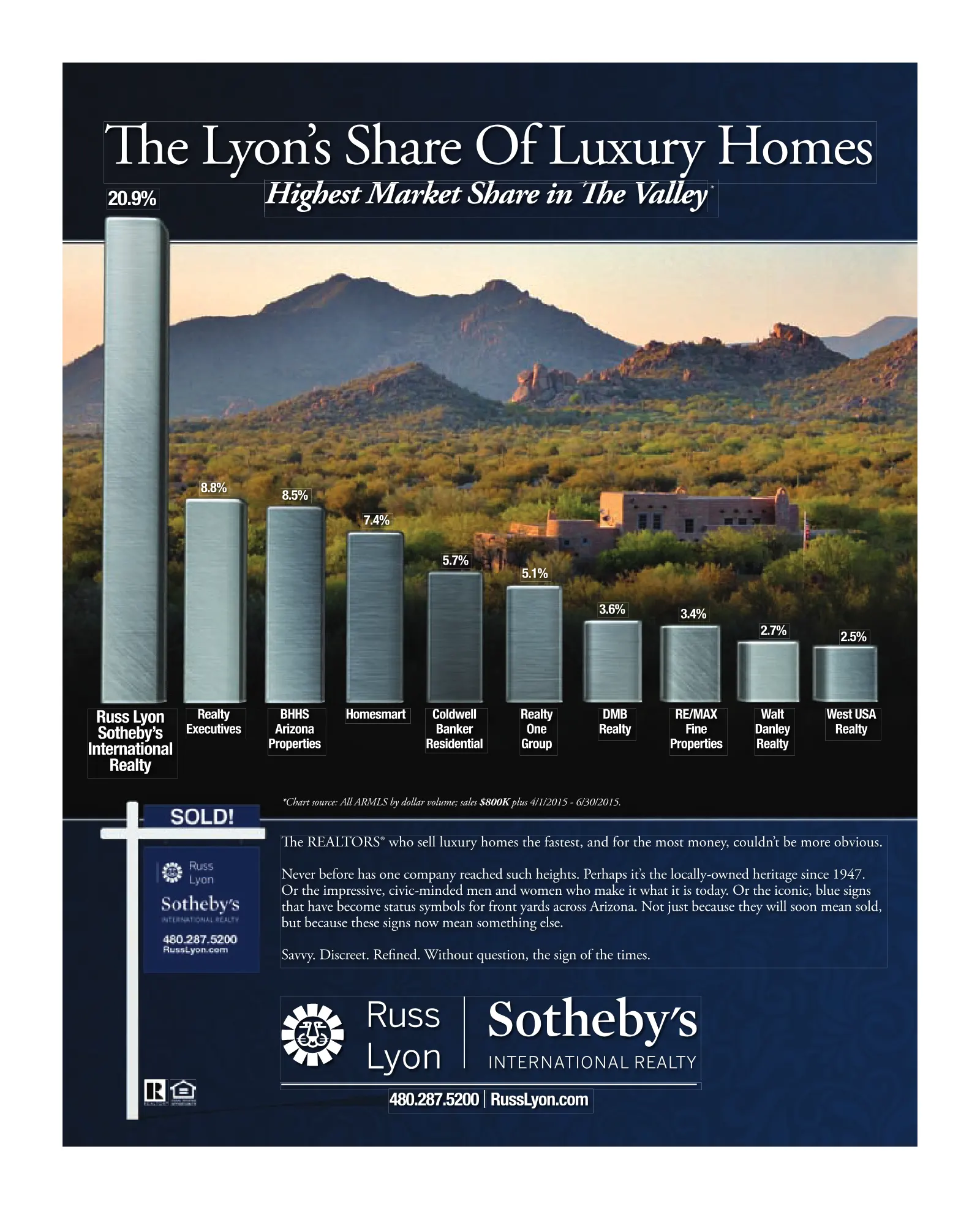
Highest Market Share in The Valley * Highest Market Share in The Valley The Lyon’s Share Of Luxury Homes The REALTORS® who sell luxury homes the fastest, and for the most money, couldn’t be more obvious. Never before has one company reached such heights. Perhaps it’s the locally-owned heritage since 1947. Or the impressive, civic-minded men and women who make it what it is today. Or the iconic, blue signs that have become status symbols for front yards across Arizona. Not just because they will soon mean sold, but because these signs now mean something else. Savvy. Discreet. Refined. Without question, the sign of the times. 480.287.5200 | RussLyon.com *Chart source: All ARMLS by dollar volume; sales $800K plus 4/1/2015 - 6/30/2015. Russ Lyon Sotheby’s International Realty Realty Executives BHHS Arizona Properties Homesmart Coldwell Banker Residential Realty One Group DMB Realty RE/MAX Fine Properties Walt Danley Realty West USA Realty 2.5% 2.7% 3.4% 3.6% 5.1% 5.7% 7.4% 8.5% 8.8% 20.9%
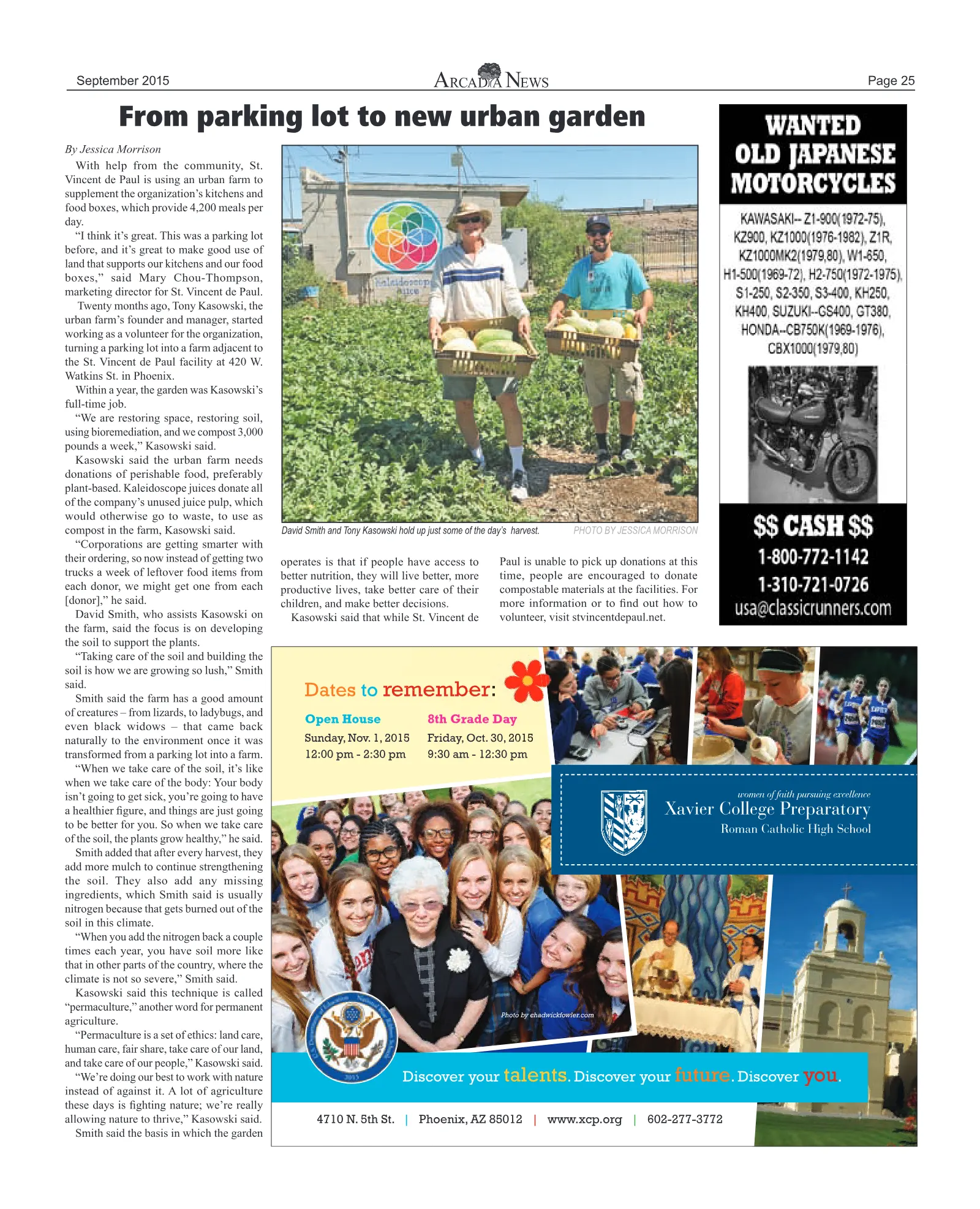
Open House Sunday, Nov. 1, 2015 12:00 pm - 2:30 pm 8th Grade Day Friday, Oct. 30, 2015 9:30 am - 12:30 pm 4710 N. 5th St. | Phoenix, AZ 85012 | www.xcp.org | 602-277-3772 Photo by chadwickfowler.com Discover your talents. Discover your future. Discover you. Dates to remember: 8th Grade Day Friday, Oct. 30, 2015 remember : Page 25 September 2015 By Jessica Morrison With help from the community, St. Vincent de Paul is using an urban farm to supplement the organization’s kitchens and food boxes, which provide 4,200 meals per day. “I think it’s great. This was a parking lot before, and it’s great to make good use of land that supports our kitchens and our food boxes,” said Mary Chou-Thompson, marketing director for St. Vincent de Paul. Twenty months ago, Tony Kasowski, the urban farm’s founder and manager, started working as a volunteer for the organization, turning a parking lot into a farm adjacent to the St. Vincent de Paul facility at 420 W. Watkins St. in Phoenix. Within a year, the garden was Kasowski’s full-time job. “We are restoring space, restoring soil, using bioremediation, and we compost 3,000 pounds a week,” Kasowski said. Kasowski said the urban farm needs donations of perishable food, preferably plant-based. Kaleidoscope juices donate all of the company’s unused juice pulp, which would otherwise go to waste, to use as compost in the farm, Kasowski said. “Corporations are getting smarter with their ordering, so now instead of getting two trucks a week of leftover food items from each donor, we might get one from each [donor],” he said. David Smith, who assists Kasowski on the farm, said the focus is on developing the soil to support the plants. “Taking care of the soil and building the soil is how we are growing so lush,” Smith said. Smith said the farm has a good amount of creatures – from lizards, to ladybugs, and even black widows – that came back naturally to the environment once it was transformed from a parking lot into a farm. “When we take care of the soil, it’s like when we take care of the body: Your body isn’t going to get sick, you’re going to have a healthier figure, and things are just going to be better for you. So when we take care of the soil, the plants grow healthy,” he said. Smith added that after every harvest, they add more mulch to continue strengthening the soil. They also add any missing ingredients, which Smith said is usually nitrogen because that gets burned out of the soil in this climate. “When you add the nitrogen back a couple times each year, you have soil more like that in other parts of the country, where the climate is not so severe,” Smith said. Kasowski said this technique is called “permaculture,” another word for permanent agriculture. “Permaculture is a set of ethics: land care, human care, fair share, take care of our land, and take care of our people,” Kasowski said. “We’re doing our best to work with nature instead of against it. A lot of agriculture these days is fighting nature; we’re really allowing nature to thrive,” Kasowski said. Smith said the basis in which the garden operates is that if people have access to better nutrition, they will live better, more productive lives, take better care of their children, and make better decisions. Kasowski said that while St. Vincent de Paul is unable to pick up donations at this time, people are encouraged to donate compostable materials at the facilities. For more information or to find out how to volunteer, visit stvincentdepaul.net. From parking lot to new urban garden David Smith and Tony Kasowski hold up just some of the day’s harvest. PHOTO BY JESSICA MORRISON