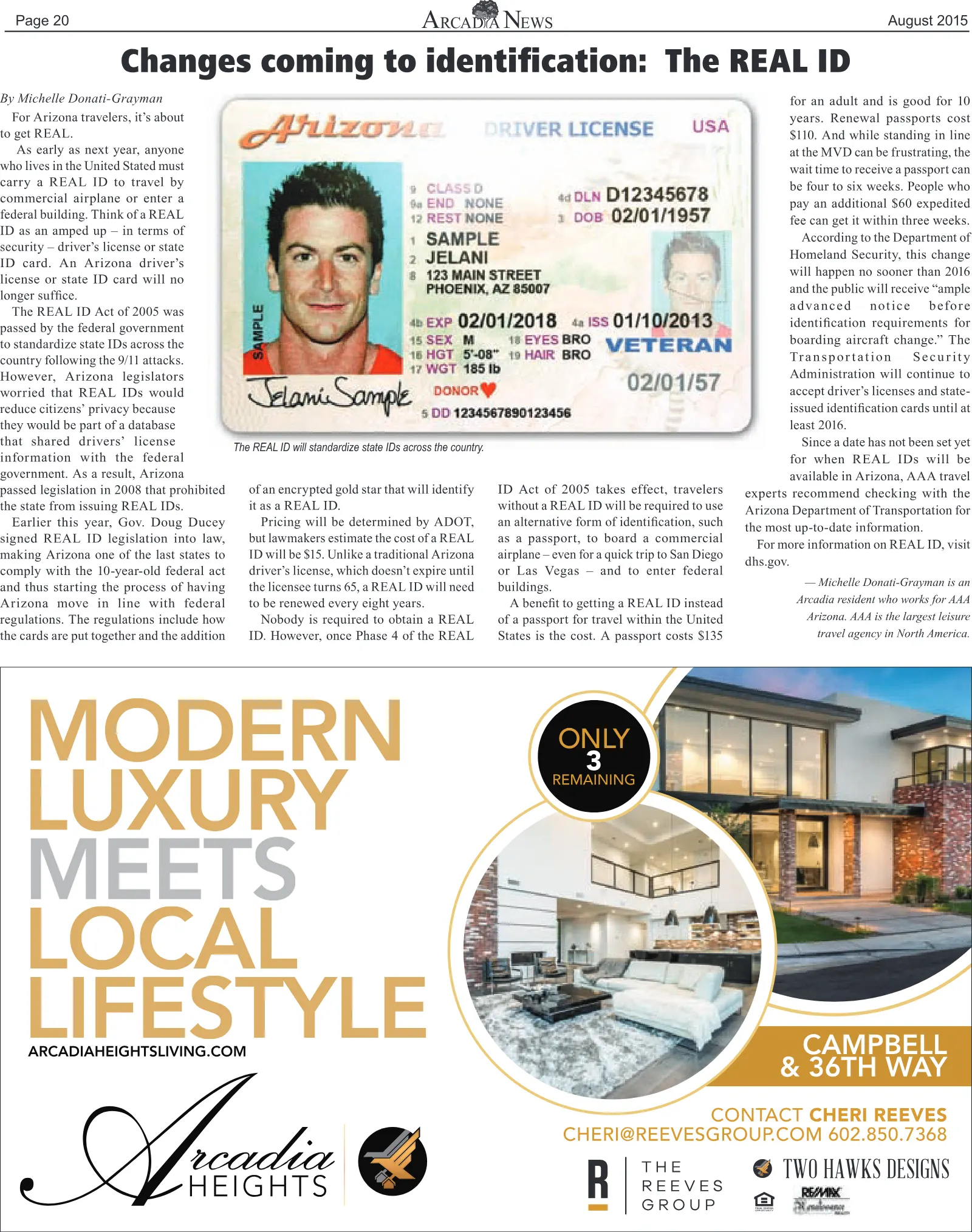
MODERN LUXURY MEETS LOCAL LIFESTYLE TWO HAWKS DESIGNS ARCADIAHEIGHTSLIVING.COM CONTACT CHERI REEVES CHERI@REEVESGROUP.COM 602.850.7368 CAMPBELL & 36TH WAY ONLY 3 REMAINING Page 20 August 2015 By Michelle Donati-Grayman For Arizona travelers, it’s about to get REAL. As early as next year, anyone who lives in the United Stated must carry a REAL ID to travel by commercial airplane or enter a federal building. Think of a REAL ID as an amped up – in terms of security – driver’s license or state ID card. An Arizona driver’s license or state ID card will no longer suffice. The REAL ID Act of 2005 was passed by the federal government to standardize state IDs across the country following the 9/11 attacks. However, Arizona legislators worried that REAL IDs would reduce citizens’ privacy because they would be part of a database that shared drivers’ license information with the federal government. As a result, Arizona passed legislation in 2008 that prohibited the state from issuing REAL IDs. Earlier this year, Gov. Doug Ducey signed REAL ID legislation into law, making Arizona one of the last states to comply with the 10-year-old federal act and thus starting the process of having Arizona move in line with federal regulations. The regulations include how the cards are put together and the addition of an encrypted gold star that will identify it as a REAL ID. Pricing will be determined by ADOT, but lawmakers estimate the cost of a REAL ID will be $15. Unlike a traditional Arizona driver’s license, which doesn’t expire until the licensee turns 65, a REAL ID will need to be renewed every eight years. Nobody is required to obtain a REAL ID. However, once Phase 4 of the REAL ID Act of 2005 takes effect, travelers without a REAL ID will be required to use an alternative form of identification, such as a passport, to board a commercial airplane – even for a quick trip to San Diego or Las Vegas – and to enter federal buildings. A benefit to getting a REAL ID instead of a passport for travel within the United States is the cost. A passport costs $135 for an adult and is good for 10 years. Renewal passports cost $110. And while standing in line at the MVD can be frustrating, the wait time to receive a passport can be four to six weeks. People who pay an additional $60 expedited fee can get it within three weeks. According to the Department of Homeland Security, this change will happen no sooner than 2016 and the public will receive “ample a dva nc e d not ic e b efor e identification requirements for boarding aircraft change.” The Tr a n s p o r t a t i o n S e c u r i t y Administration will continue to accept driver’s licenses and state- issued identification cards until at least 2016. Since a date has not been set yet for when REAL IDs will be available in Arizona, AAA travel experts recommend checking with the Arizona Department of Transportation for the most up-to-date information. For more information on REAL ID, visit dhs.gov. — Michelle Donati-Grayman is an Arcadia resident who works for AAA Arizona. AAA is the largest leisure travel agency in North America. Changes coming to identification: The REAL ID The REAL ID will standardize state IDs across the country.
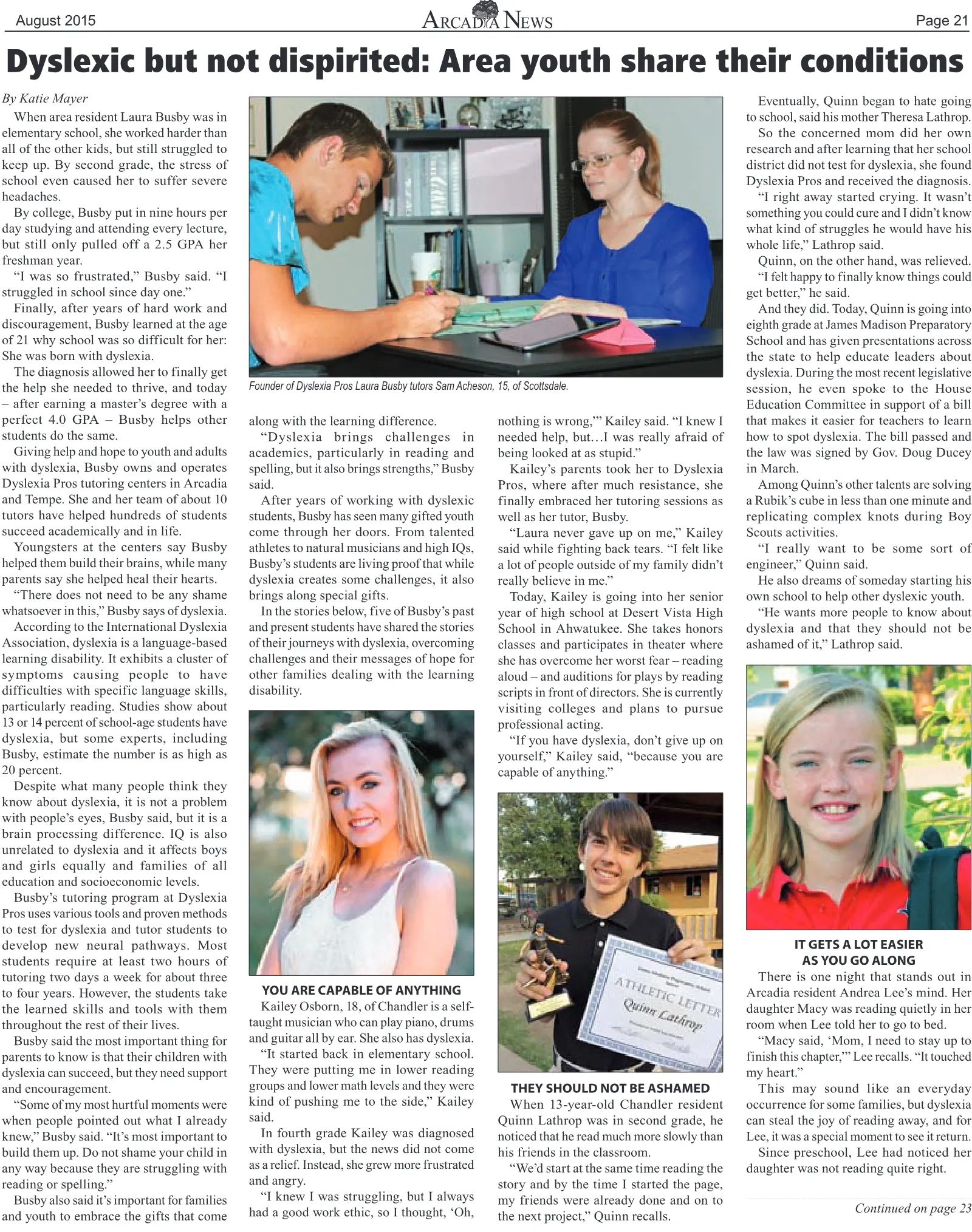
Page 21 August 2015 By Katie Mayer When area resident Laura Busby was in elementary school, she worked harder than all of the other kids, but still struggled to keep up. By second grade, the stress of school even caused her to suffer severe headaches. By college, Busby put in nine hours per day studying and attending every lecture, but still only pulled off a 2.5 GPA her freshman year. “I was so frustrated,” Busby said. “I struggled in school since day one.” Finally, after years of hard work and discouragement, Busby learned at the age of 21 why school was so difficult for her: She was born with dyslexia. The diagnosis allowed her to finally get the help she needed to thrive, and today – after earning a master’s degree with a perfect 4.0 GPA – Busby helps other students do the same. Giving help and hope to youth and adults with dyslexia, Busby owns and operates Dyslexia Pros tutoring centers in Arcadia and Tempe. She and her team of about 10 tutors have helped hundreds of students succeed academically and in life. Youngsters at the centers say Busby helped them build their brains, while many parents say she helped heal their hearts. “There does not need to be any shame whatsoever in this,” Busby says of dyslexia. According to the International Dyslexia Association, dyslexia is a language-based learning disability. It exhibits a cluster of symptoms causing people to have difficulties with specific language skills, particularly reading. Studies show about 13 or 14 percent of school-age students have dyslexia, but some experts, including Busby, estimate the number is as high as 20 percent. Despite what many people think they know about dyslexia, it is not a problem with people’s eyes, Busby said, but it is a brain processing difference. IQ is also unrelated to dyslexia and it affects boys and girls equally and families of all education and socioeconomic levels. Busby’s tutoring program at Dyslexia Pros uses various tools and proven methods to test for dyslexia and tutor students to develop new neural pathways. Most students require at least two hours of tutoring two days a week for about three to four years. However, the students take the learned skills and tools with them throughout the rest of their lives. Busby said the most important thing for parents to know is that their children with dyslexia can succeed, but they need support and encouragement. “Some of my most hurtful moments were when people pointed out what I already knew,” Busby said. “It’s most important to build them up. Do not shame your child in any way because they are struggling with reading or spelling.” Busby also said it’s important for families and youth to embrace the gifts that come along with the learning difference. “Dyslexia brings challenges in academics, particularly in reading and spelling, but it also brings strengths,” Busby said. After years of working with dyslexic students, Busby has seen many gifted youth come through her doors. From talented athletes to natural musicians and high IQs, Busby’s students are living proof that while dyslexia creates some challenges, it also brings along special gifts. In the stories below, five of Busby’s past and present students have shared the stories of their journeys with dyslexia, overcoming challenges and their messages of hope for other families dealing with the learning disability. YOU ARE CAPABLE OF ANYTHING Kailey Osborn, 18, of Chandler is a self- taught musician who can play piano, drums and guitar all by ear. She also has dyslexia. “It started back in elementary school. They were putting me in lower reading groups and lower math levels and they were kind of pushing me to the side,” Kailey said. In fourth grade Kailey was diagnosed with dyslexia, but the news did not come as a relief. Instead, she grew more frustrated and angry. “I knew I was struggling, but I always had a good work ethic, so I thought, ‘Oh, nothing is wrong,’” Kailey said. “I knew I needed help, but…I was really afraid of being looked at as stupid.” Kailey’s parents took her to Dyslexia Pros, where after much resistance, she finally embraced her tutoring sessions as well as her tutor, Busby. “Laura never gave up on me,” Kailey said while fighting back tears. “I felt like a lot of people outside of my family didn’t really believe in me.” Today, Kailey is going into her senior year of high school at Desert Vista High School in Ahwatukee. She takes honors classes and participates in theater where she has overcome her worst fear – reading aloud – and auditions for plays by reading scripts in front of directors. She is currently visiting colleges and plans to pursue professional acting. “If you have dyslexia, don’t give up on yourself,” Kailey said, “because you are capable of anything.” THEY SHOULD NOT BE ASHAMED When 13-year-old Chandler resident Quinn Lathrop was in second grade, he noticed that he read much more slowly than his friends in the classroom. “We’d start at the same time reading the story and by the time I started the page, my friends were already done and on to the next project,” Quinn recalls. Eventually, Quinn began to hate going to school, said his mother Theresa Lathrop. So the concerned mom did her own research and after learning that her school district did not test for dyslexia, she found Dyslexia Pros and received the diagnosis. “I right away started crying. It wasn’t something you could cure and I didn’t know what kind of struggles he would have his whole life,” Lathrop said. Quinn, on the other hand, was relieved. “I felt happy to finally know things could get better,” he said. And they did. Today, Quinn is going into eighth grade at James Madison Preparatory School and has given presentations across the state to help educate leaders about dyslexia. During the most recent legislative session, he even spoke to the House Education Committee in support of a bill that makes it easier for teachers to learn how to spot dyslexia. The bill passed and the law was signed by Gov. Doug Ducey in March. Among Quinn’s other talents are solving a Rubik’s cube in less than one minute and replicating complex knots during Boy Scouts activities. “I really want to be some sort of engineer,” Quinn said. He also dreams of someday starting his own school to help other dyslexic youth. “He wants more people to know about dyslexia and that they should not be ashamed of it,” Lathrop said. IT GETS A LOT EASIER AS YOU GO ALONG There is one night that stands out in Arcadia resident Andrea Lee’s mind. Her daughter Macy was reading quietly in her room when Lee told her to go to bed. “Macy said, ‘Mom, I need to stay up to finish this chapter,’” Lee recalls. “It touched my heart.” This may sound like an everyday occurrence for some families, but dyslexia can steal the joy of reading away, and for Lee, it was a special moment to see it return. Since preschool, Lee had noticed her daughter was not reading quite right. Dyslexic but not dispirited: Area youth share their conditions Founder of Dyslexia Pros Laura Busby tutors Sam Acheson, 15, of Scottsdale. Continued on page 23