
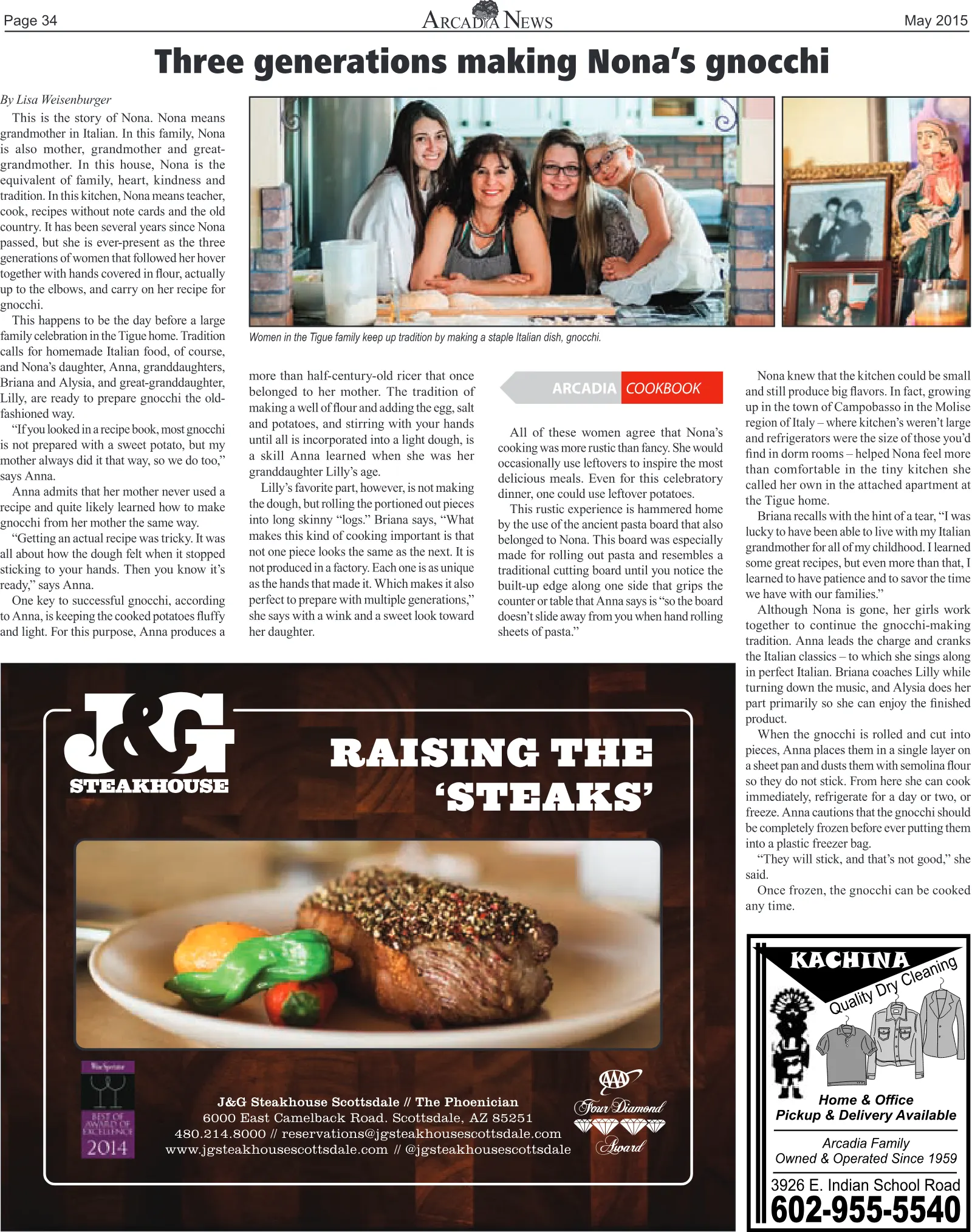
Page 34 May 2015 By Lisa Weisenburger This is the story of Nona. Nona means grandmother in Italian. In this family, Nona is also mother, grandmother and great- grandmother. In this house, Nona is the equivalent of family, heart, kindness and tradition. In this kitchen, Nona means teacher, cook, recipes without note cards and the old country. It has been several years since Nona passed, but she is ever-present as the three generations of women that followed her hover together with hands covered in fl our, actually up to the elbows, and carry on her recipe for gnocchi. This happens to be the day before a large family celebration in the Tigue home. Tradition calls for homemade Italian food, of course, and Nona’s daughter, Anna, granddaughters, Briana and Alysia, and great-granddaughter, Lilly, are ready to prepare gnocchi the old- fashioned way. “If you looked in a recipe book, most gnocchi is not prepared with a sweet potato, but my mother always did it that way, so we do too,” says Anna. Anna admits that her mother never used a recipe and quite likely learned how to make gnocchi from her mother the same way. “Getting an actual recipe was tricky. It was all about how the dough felt when it stopped sticking to your hands. Then you know it’s ready,” says Anna. One key to successful gnocchi, according to Anna, is keeping the cooked potatoes fl uffy and light. For this purpose, Anna produces a more than half-century-old ricer that once belonged to her mother. The tradition of making a well of fl our and adding the egg, salt and potatoes, and stirring with your hands until all is incorporated into a light dough, is a skill Anna learned when she was her granddaughter Lilly’s age. Lilly’s favorite part, however, is not making the dough, but rolling the portioned out pieces into long skinny “logs.” Briana says, “What makes this kind of cooking important is that not one piece looks the same as the next. It is not produced in a factory. Each one is as unique as the hands that made it. Which makes it also perfect to prepare with multiple generations,” she says with a wink and a sweet look toward her daughter. All of these women agree that Nona’s cooking was more rustic than fancy. She would occasionally use leftovers to inspire the most delicious meals. Even for this celebratory dinner, one could use leftover potatoes. This rustic experience is hammered home by the use of the ancient pasta board that also belonged to Nona. This board was especially made for rolling out pasta and resembles a traditional cutting board until you notice the built-up edge along one side that grips the counter or table that Anna says is “so the board doesn’t slide away from you when hand rolling sheets of pasta.” Nona knew that the kitchen could be small and still produce big fl avors. In fact, growing up in the town of Campobasso in the Molise region of Italy – where kitchen’s weren’t large and refrigerators were the size of those you’d fi nd in dorm rooms – helped Nona feel more than comfortable in the tiny kitchen she called her own in the attached apartment at the Tigue home. Briana recalls with the hint of a tear, “I was lucky to have been able to live with my Italian grandmother for all of my childhood. I learned some great recipes, but even more than that, I learned to have patience and to savor the time we have with our families.” Although Nona is gone, her girls work together to continue the gnocchi-making tradition. Anna leads the charge and cranks the Italian classics – to which she sings along in perfect Italian. Briana coaches Lilly while turning down the music, and Alysia does her part primarily so she can enjoy the fi nished product. When the gnocchi is rolled and cut into pieces, Anna places them in a single layer on a sheet pan and dusts them with semolina fl our so they do not stick. From here she can cook immediately, refrigerate for a day or two, or freeze. Anna cautions that the gnocchi should be completely frozen before ever putting them into a plastic freezer bag. “They will stick, and that’s not good,” she said. Once frozen, the gnocchi can be cooked any time. Women in the Tigue family keep up tradition by making a staple Italian dish, gnocchi. ARCADIA COOKBOOK Three generations making Nona’s gnocchi KACHINA Quality Dry Cleaning 602-955-5540 3926 E. Indian School Road Arcadia Family Owned & Operated Since 1959 Home & Office Pickup & Delivery Available
Page 35 May 2015 As with all pastas, the prepped gnocchi are cooked in boiling, salted water. (It’s probably OK if your pasta pot isn’t 50 years old.) When the question of doneness was posed, Briana and Alysia responded in unison, “When they fl oat.” Anna also added, “And when they get puffy. Then you will have light and tender gnocchi.” When the group was asked about favorite sauces, everyone had a different answer. “Sometimes plain butter is my favorite,” said Lilly. Briana enjoys the pesto cream sauce, which is featured today. Anna says she likes gnocchi with a traditional red sauce but her favorite is to sauté the cooked gnocchi with butter and fresh thyme. Because Alysia is Anna’s third daughter, she’s not picky when it comes to homemade anything. “I like them all,” she said. Three generations are often found in the Tigue’s kitchen, but this story is about the fourth – and most senior – generation. Glancing over at the shelf of treasured keepsakes and pictures of Nona, aptly placed right by the kitchen, one can absolutely hear her saying, “Buon appetito! Mangia! Mangia!” NONA’S GNOCCHI • 4 large russet potatoes • 1 large sweet potato • 2 to 3 cups of fl our (may need more depending on wetness of potatoes and size of eggs) • 2 large eggs • salt • additional fl our for dusting • semolina fl our for non-stick purposes Peel potatoes, cut in quarters. Bring a large pot with lightly salted water to a boil. Boil potatoes until fork tender. Drain. Allow potatoes to cool until able to handle, but still warm. Using a ricer, mash the cooked potatoes. Allow them to loosely pile in a bowl or on a baking sheet, keeping fluffy. A food mill will also work nicely. On a solid surface, make a well with the flour. Add eggs and salt. Stir with fingers until barely combined and add potato mixture. Combine ingredients, adding additional flour as necessary until dough does not stick to fingers. Separate quantities of dough so that when rolled out, the dough forms a log that measures approximately 10 to 12 inches long and has a 1-inch diameter. With a knife or pastry cutter, slice 1-inch pieces and place in single layer on sheet pan. Sprinkle with semolina flour to avoid sticking. Use immediately by placing in boiling water until the gnocchi float and are puffed up. Drain. Serve tossed with favorite sauce (see below). Pesto Cream Sauce • 1/2 to 3/4 cup homemade pesto (recipe below) • 2 cups cream • 2 to 3 tablespoons butter • salt and pepper to taste • Grated Parmesan or Romano cheese • In a large skillet, stir all ingredients together. Toss with cooked gnocchi. Sprinkle with grated cheese just before serving. Anna’s Homemade Pesto • 2 cups packed fresh basil leaves • 2 cloves garlic • salt and freshly ground black pepper to taste • 1/2 cup freshly grated Parmesan cheese • extra-virgin olive oil Using a food processor, blend basil, garlic, salt, pepper and cheese, adding olive until smooth and relatively thick, approximately 2/3 cup. Refrigerate. Best if made in advance. Can be frozen in airtight container for several months. If you would like to be featured in Arcadia Cookbook, contact Amanda: amanda@arcadianews.com Continued from page 34 602-956-0178 4144 E. Indian School Rd. Daily specials! Happy hour: 3-6 pm daily. JOIN US for FOOD and FUN