

Page 20 April 2015 By Amanda Goossen Robust vegetable gardens are popping up throughout the Valley, as the push for locally grown produce continues to be a popular choice with Phoenicians, as well as communities all over the United States. More than just a food fad, the farm-to-table movement has changed the way we eat, purchase and prepare our food. Farm-to-table can be seen as not only a food movement but also as a nutrition movement. In a study done by the Leopold Center for Sustainable Agriculture about 16 common fruits and vegetables, the average produce item travelled just under 1,500 miles before it was sold to a consumer. Additionally, 39 percent of fruits and 12 percent of vegetables were imported from other countries. To keep food from spoiling, produce is picked before it has the chance to ripen. According to the United States Department of Agriculture, this method causes produce to lack the nutrients that would be present if it was allowed to ripen on the vine. With this in mind, farm-to-table has caused a growing number of Americans to investigate what they put on the plate, to purchase food from local farmers markets, and to design and cultivate their own backyard garden. Restaurants and schools are also getting involved, developing on-site gardens that provide produce with which to cook as well as educate. The Arcadia Neighborhood Learning Center, a K-8 school in Arcadia, has spent the last three years developing their own garden, greenhouse and educational program based on their fruits and vegetables. Local chefs participate in cooking lessons once a month, using science, reading and math with large groups of students. In 2014-15, Ingleside Middle School created an after-school garden class run by teachers and volunteer gardener Barbara Halden. Barbara, responsible for building the Hopi Elementary School garden in past years, has now tackled the soil with middle school children, instructing them on the growth and harvesting process, as well as the distribution of their products. “The kids sell their produce every month at the Arcadia Farmers’ Market,” said Halden. “The income goes back into the garden fund for items needed in the garden. The students learn how to harvest, package and promote their veggies, herbs, seeds and flowers. We recently designed our own banner and paid with our earned money for the printing.” At area restaurants, chefs and owners are also bringing the farm closer to the table by building garden boxes above the ground with rows of herbs and vegetables. Citrus trees natural to the area are also part of some Chef Charles Kassels (left) came on as chef of El Chorro in 2009, the same year the garden was built. (Middle) An Ingleside Middle School student works the booth at the Arcadia Farmers Market, selling the Garden Clubs produce. (Right) An Arcadia Neighborhood Learning Center student helps plant new seeds for the school garden. Farm-to-table movement arrives at schools, restaurants YOU’RE WARMLY INVITED 3200 East Glenrosa Avenue MorningStarSeniorLiving.com 480.300.4700 Dementia Care iver Support Group It’s About Empathy—and Education Every 2nd Wednesday • 6:00 PM
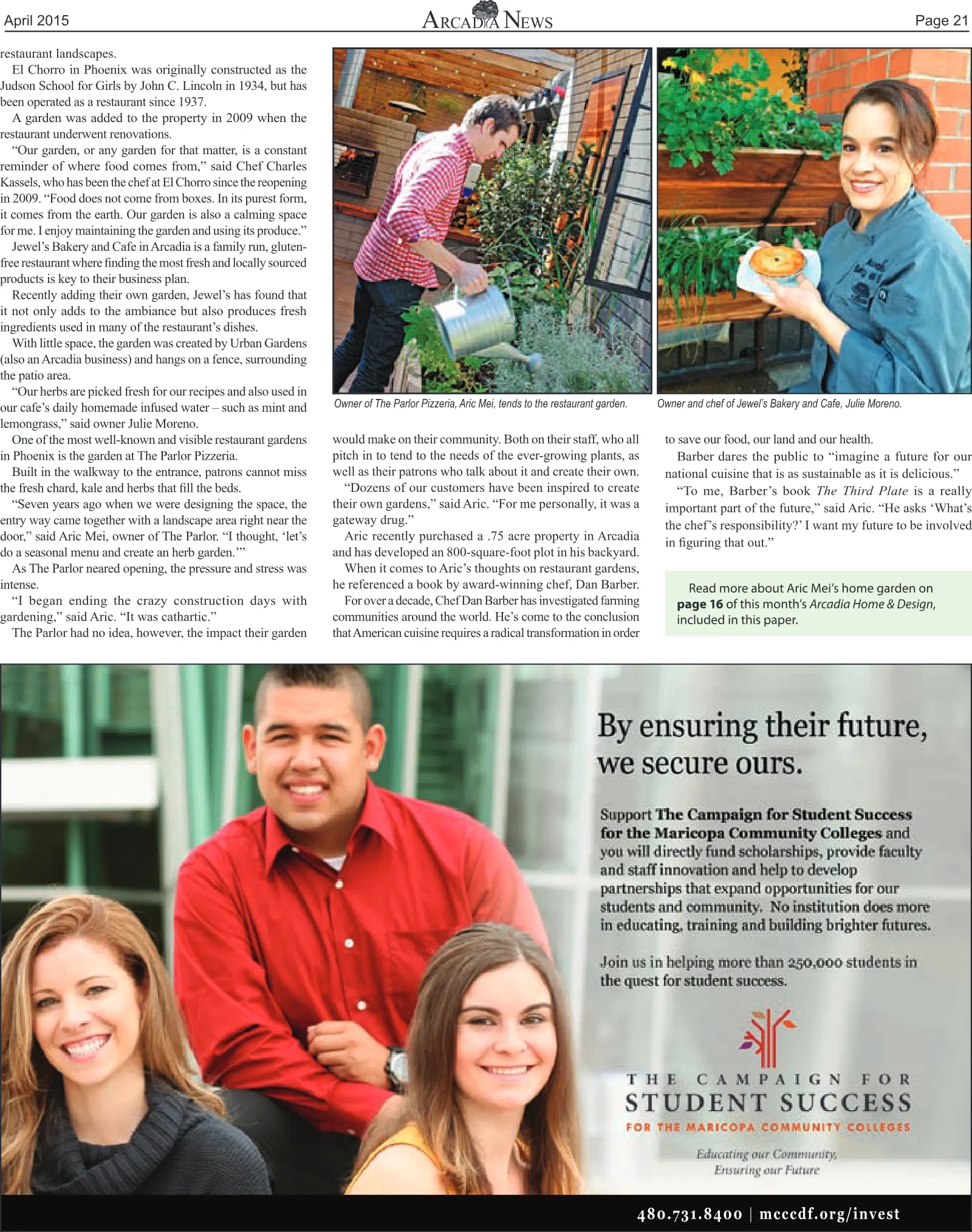
Page 21 April 2015 restaurant landscapes. El Chorro in Phoenix was originally constructed as the Judson School for Girls by John C. Lincoln in 1934, but has been operated as a restaurant since 1937. A garden was added to the property in 2009 when the restaurant underwent renovations. “Our garden, or any garden for that matter, is a constant reminder of where food comes from,” said Chef Charles Kassels, who has been the chef at El Chorro since the reopening in 2009. “Food does not come from boxes. In its purest form, it comes from the earth. Our garden is also a calming space for me. I enjoy maintaining the garden and using its produce.” Jewel’s Bakery and Cafe in Arcadia is a family run, gluten- free restaurant where finding the most fresh and locally sourced products is key to their business plan. Recently adding their own garden, Jewel’s has found that it not only adds to the ambiance but also produces fresh ingredients used in many of the restaurant’s dishes. With little space, the garden was created by Urban Gardens (also an Arcadia business) and hangs on a fence, surrounding the patio area. “Our herbs are picked fresh for our recipes and also used in our cafe’s daily homemade infused water – such as mint and lemongrass,” said owner Julie Moreno. One of the most well-known and visible restaurant gardens in Phoenix is the garden at The Parlor Pizzeria. Built in the walkway to the entrance, patrons cannot miss the fresh chard, kale and herbs that fill the beds. “Seven years ago when we were designing the space, the entry way came together with a landscape area right near the door,” said Aric Mei, owner of The Parlor. “I thought, ‘let’s do a seasonal menu and create an herb garden.’” As The Parlor neared opening, the pressure and stress was intense. “I began ending the crazy construction days with gardening,” said Aric. “It was cathartic.” The Parlor had no idea, however, the impact their garden would make on their community. Both on their staff, who all pitch in to tend to the needs of the ever-growing plants, as well as their patrons who talk about it and create their own. “Dozens of our customers have been inspired to create their own gardens,” said Aric. “For me personally, it was a gateway drug.” Aric recently purchased a .75 acre property in Arcadia and has developed an 800-square-foot plot in his backyard. When it comes to Aric’s thoughts on restaurant gardens, he referenced a book by award-winning chef, Dan Barber. For over a decade, Chef Dan Barber has investigated farming communities around the world. He’s come to the conclusion that American cuisine requires a radical transformation in order to save our food, our land and our health. Barber dares the public to “imagine a future for our national cuisine that is as sustainable as it is delicious.” “To me, Barber’s book The Third Plate is a really important part of the future,” said Aric. “He asks ‘What’s the chef’s responsibility?’ I want my future to be involved in figuring that out.” Owner of The Parlor Pizzeria, Aric Mei, tends to the restaurant garden. Owner and chef of Jewel’s Bakery and Cafe, Julie Moreno. 4 8 0 . 7 3 1 . 8 4 0 0 | m c c c d f . o r g / i n v e s t By ensuring their future, we secure ours. Support The Campaign for Student Success for the Maricopa Community Colleges and you will directly fund scholarships, provide faculty and staff innovation and help to develop partnerships that expand opportunities for our students and community. No institution does more in educating, training and building brighter futures. Join us in helping more than 250,000 students in Join us in helping more than 250,000 students in the quest for student success. Read more about Aric Mei’s home garden on page 16 of this month’s Arcadia Home & Design , included in this paper.