
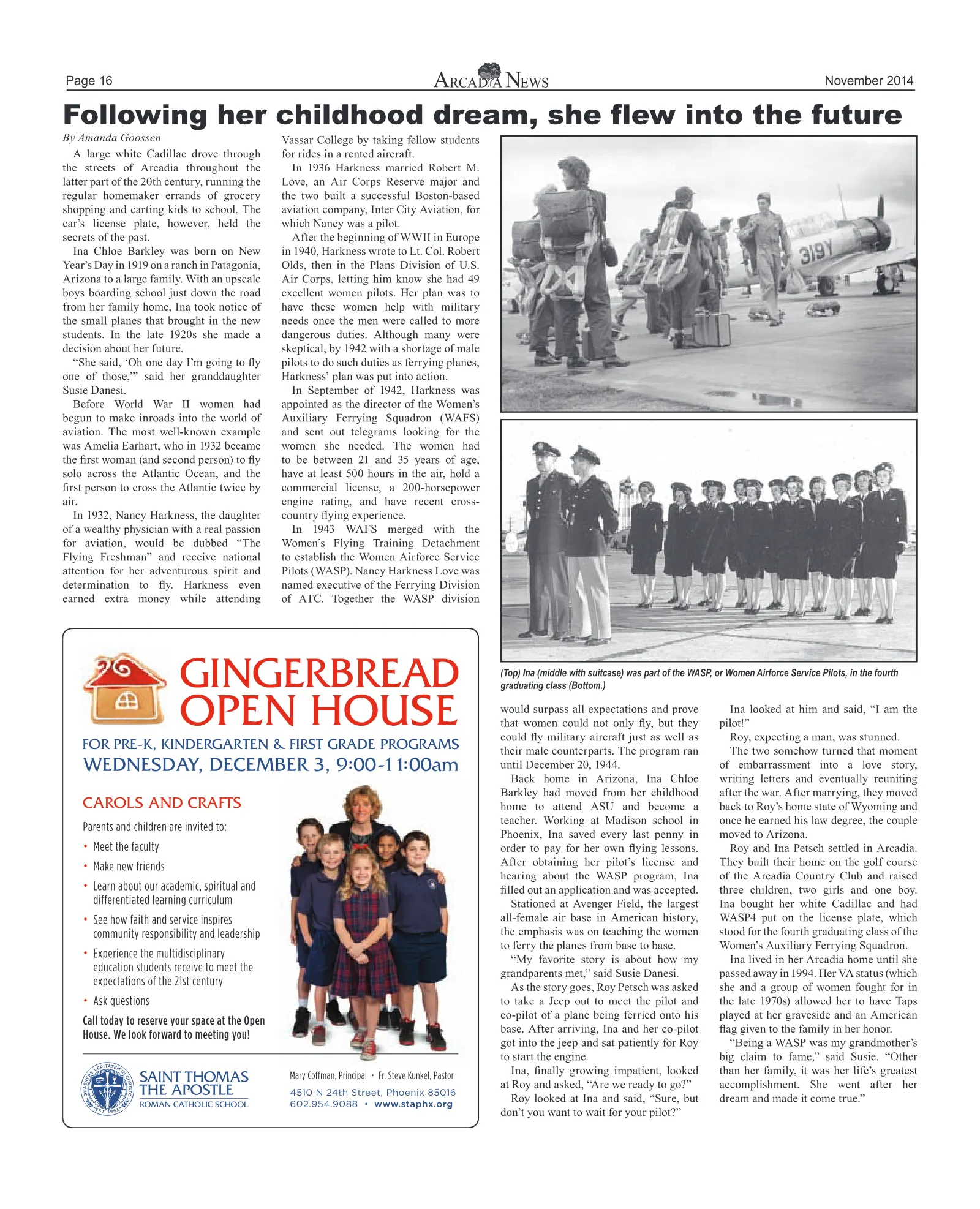

Page 16 November 2 0 14 By Amanda Goossen A large white Cadillac drove through the streets of Arcadia throughout the latter part of the 20th century, running the regular homemaker errands of grocery shopping and carting kids to school. The car’s license plate, however, held the secrets of the past. Ina Chloe Barkley was born on New Year’s Day in 1919 on a ranch in Patagonia, Arizona to a large family. With an upscale boys boarding school just down the road from her family home, Ina took notice of the small planes that brought in the new students. In the late 1920s she made a decision about her future. “She said, ‘Oh one day I’m going to fly one of those,’” said her granddaughter Susie Danesi. Before World War II women had begun to make inroads into the world of aviation. The most well-known example was Amelia Earhart, who in 1932 became the first woman (and second person) to fly solo across the Atlantic Ocean, and the first person to cross the Atlantic twice by air. In 1932, Nancy Harkness, the daughter of a wealthy physician with a real passion for aviation, would be dubbed “The Flying Freshman” and receive national attention for her adventurous spirit and determination to fly. Harkness even earned extra money while attending Following her childhood dream, she flew into the future Vassar College by taking fellow students for rides in a rented aircraft. In 1936 Harkness married Robert M. Love, an Air Corps Reserve major and the two built a successful Boston-based aviation company, Inter City Aviation, for which Nancy was a pilot. After the beginning of WWII in Europe in 1940, Harkness wrote to Lt. Col. Robert Olds, then in the Plans Division of U.S. Air Corps, letting him know she had 49 excellent women pilots. Her plan was to have these women help with military needs once the men were called to more dangerous duties. Although many were skeptical, by 1942 with a shortage of male pilots to do such duties as ferrying planes, Harkness’ plan was put into action. In September of 1942, Harkness was appointed as the director of the Women’s Auxiliary Ferrying Squadron (WAFS) and sent out telegrams looking for the women she needed. The women had to be between 21 and 35 years of age, have at least 500 hours in the air, hold a commercial license, a 200-horsepower engine rating, and have recent cross- country flying experience. In 1943 WAFS merged with the Women’s Flying Training Detachment to establish the Women Airforce Service Pilots (WASP). Nancy Harkness Love was named executive of the Ferrying Division of ATC. Together the WASP division would surpass all expectations and prove that women could not only fly, but they could fly military aircraft just as well as their male counterparts. The program ran until December 20, 1944. Back home in Arizona, Ina Chloe Barkley had moved from her childhood home to attend ASU and become a teacher. Working at Madison school in Phoenix, Ina saved every last penny in order to pay for her own flying lessons. After obtaining her pilot’s license and hearing about the WASP program, Ina filled out an application and was accepted. Stationed at Avenger Field, the largest all-female air base in American history, the emphasis was on teaching the women to ferry the planes from base to base. “My favorite story is about how my grandparents met,” said Susie Danesi. As the story goes, Roy Petsch was asked to take a Jeep out to meet the pilot and co-pilot of a plane being ferried onto his base. After arriving, Ina and her co-pilot got into the jeep and sat patiently for Roy to start the engine. Ina, finally growing impatient, looked at Roy and asked, “Are we ready to go?” Roy looked at Ina and said, “Sure, but don’t you want to wait for your pilot?” Ina looked at him and said, “I am the pilot!” Roy, expecting a man, was stunned. The two somehow turned that moment of embarrassment into a love story, writing letters and eventually reuniting after the war. After marrying, they moved back to Roy’s home state of Wyoming and once he earned his law degree, the couple moved to Arizona. Roy and Ina Petsch settled in Arcadia. They built their home on the golf course of the Arcadia Country Club and raised three children, two girls and one boy. Ina bought her white Cadillac and had WASP4 put on the license plate, which stood for the fourth graduating class of the Women’s Auxiliary Ferrying Squadron. Ina lived in her Arcadia home until she passed away in 1994. Her VA status (which she and a group of women fought for in the late 1970s) allowed her to have Taps played at her graveside and an American flag given to the family in her honor. “Being a WASP was my grandmother’s big claim to fame,” said Susie. “Other than her family, it was her life’s greatest accomplishment. She went after her dream and made it come true.” (Top) Ina (middle with suitcase) was part of the WASP, or Women Airforce Service Pilots, in the fourth graduating class (Bottom.)
d, “I am the stunned. that moment love story, ly reuniting they moved yoming and e, the couple in Arcadia. golf course b and raised d one boy. lac and had plate, which g class of the Squadron. me until she status (which fought for in to have Taps an American r honor. randmother’s usie. “Other ife’s greatest t after her .” TRUST. IT’S MORE THAN A WORD TO US. IT’S OUR WORD TO YOU. Let us earn your trust today — call SCOTTSDALE AIR. RECEIVE UP TO A $ 1,700 REBATE * with the purchase of a qualifying Lennox ® home comfort system. ROC 101485 ROC 129482 OFFER EXPIRES 11/28/2014. *System rebate offers range from $300 to $1,700. See your local Lennox dealer for details. © 2014 Lennox Industries Inc. Lennox dealers include independently owned and operated businesses. One offer available per qualifying purchase. Scottsdale Air (480) 945-7200 www.scottsdaleair.com 1121 N. Sickles Dr Tempe, AZ 85281 Phoenix;Scottsdale Air Heating & Cooling;C11432;10.25x13-4c (14Fa-Early) Dealer-Trust-14Fa-4c-Early.indd 80 8/18/14 3:55 PM