
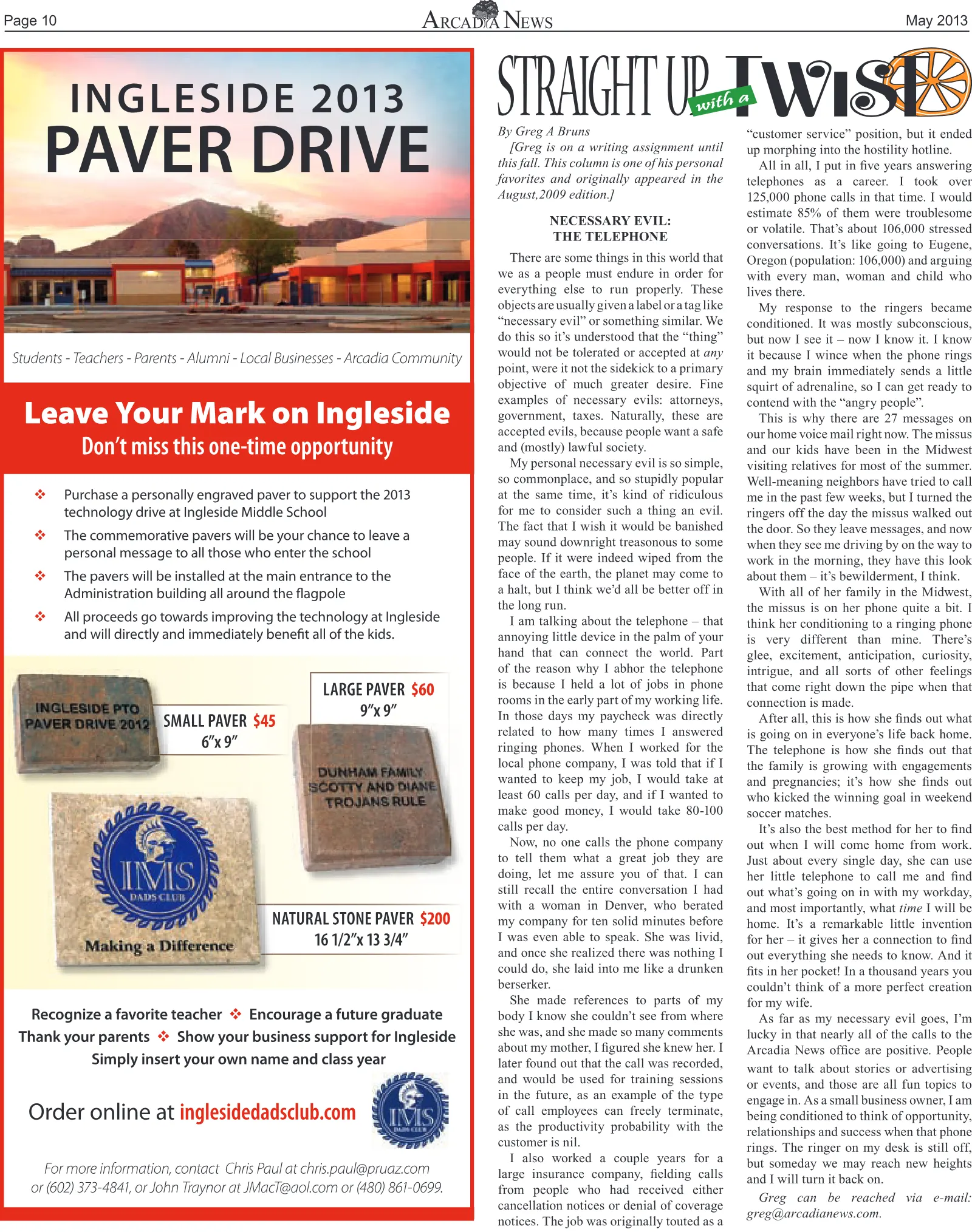
Page 10 May 2013 By Greg A Bruns [Greg is on a writing assignment until this fall. This column is one of his personal favorites and originally appeared in the August,2009 edition.] NECESSARY EVIL: THE TELEPHONE There are some things in this world that we as a people must endure in order for everything else to run properly. These objects are usually given a label or a tag like “necessary evil” or something similar. We do this so it’s understood that the “thing” would not be tolerated or accepted at any point, were it not the sidekick to a primary objective of much greater desire. Fine examples of necessary evils: attorneys, government, taxes. Naturally, these are accepted evils, because people want a safe and (mostly) lawful society. My personal necessary evil is so simple, so commonplace, and so stupidly popular at the same time, it’s kind of ridiculous for me to consider such a thing an evil. The fact that I wish it would be banished may sound downright treasonous to some people. If it were indeed wiped from the face of the earth, the planet may come to a halt, but I think we’d all be better off in the long run. I am talking about the telephone – that annoying little device in the palm of your hand that can connect the world. Part of the reason why I abhor the telephone is because I held a lot of jobs in phone rooms in the early part of my working life. In those days my paycheck was directly related to how many times I answered ringing phones. When I worked for the local phone company, I was told that if I wanted to keep my job, I would take at least 60 calls per day, and if I wanted to make good money, I would take 80-100 calls per day. Now, no one calls the phone company to tell them what a great job they are doing, let me assure you of that. I can still recall the entire conversation I had with a woman in Denver, who berated my company for ten solid minutes before I was even able to speak. She was livid, and once she realized there was nothing I could do, she laid into me like a drunken berserker. She made references to parts of my body I know she couldn’t see from where she was, and she made so many comments about my mother, I fi gured she knew her. I later found out that the call was recorded, and would be used for training sessions in the future, as an example of the type of call employees can freely terminate, as the productivity probability with the customer is nil. I also worked a couple years for a large insurance company, fi elding calls from people who had received either cancellation notices or denial of coverage notices. The job was originally touted as a “customer service” position, but it ended up morphing into the hostility hotline. All in all, I put in fi ve years answering telephones as a career. I took over 125,000 phone calls in that time. I would estimate 85% of them were troublesome or volatile. That’s about 106,000 stressed conversations. It’s like going to Eugene, Oregon (population: 106,000) and arguing with every man, woman and child who lives there. My response to the ringers became conditioned. It was mostly subconscious, but now I see it – now I know it. I know it because I wince when the phone rings and my brain immediately sends a little squirt of adrenaline, so I can get ready to contend with the “angry people”. This is why there are 27 messages on our home voice mail right now. The missus and our kids have been in the Midwest visiting relatives for most of the summer. Well-meaning neighbors have tried to call me in the past few weeks, but I turned the ringers off the day the missus walked out the door. So they leave messages, and now when they see me driving by on the way to work in the morning, they have this look about them – it’s bewilderment, I think. With all of her family in the Midwest, the missus is on her phone quite a bit. I think her conditioning to a ringing phone is very different than mine. There’s glee, excitement, anticipation, curiosity, intrigue, and all sorts of other feelings that come right down the pipe when that connection is made. After all, this is how she fi nds out what is going on in everyone’s life back home. The telephone is how she fi nds out that the family is growing with engagements and pregnancies; it’s how she fi nds out who kicked the winning goal in weekend soccer matches. It’s also the best method for her to fi nd out when I will come home from work. Just about every single day, she can use her little telephone to call me and fi nd out what’s going on in with my workday, and most importantly, what time I will be home. It’s a remarkable little invention for her – it gives her a connection to fi nd out everything she needs to know. And it fi ts in her pocket! In a thousand years you couldn’t think of a more perfect creation for my wife. As far as my necessary evil goes, I’m lucky in that nearly all of the calls to the Arcadia News of fi ce are positive. People want to talk about stories or advertising or events, and those are all fun topics to engage in. As a small business owner, I am being conditioned to think of opportunity, relationships and success when that phone rings. The ringer on my desk is still off, but someday we may reach new heights and I will turn it back on. Greg can be reached via e-mail: greg@arcadianews.com. INGLESIDE 2013 PAVER DRIVE Students - Teachers - Parents - Alumni - Local Businesses - Arcadia Community For more information, contact Chris Paul at chris.paul@pruaz.com or (602) 373-4841, or John Traynor at JMacT@aol.com or (480) 861-0699. Purchase a personally engraved paver to support the 2013 technology drive at Ingleside Middle School The commemorative pavers will be your chance to leave a personal message to all those who enter the school The pavers will be installed at the main entrance to the Administration building all around the flagpole All proceeds go towards improving the technology at Ingleside and will directly and immediately benefit all of the kids. Leave Your Mark on Ingleside Don’t miss this one-time opportunity Recognize a favorite teacher Encourage a future graduate Thank your parents Show your business support for Ingleside Simply insert your own name and class year Order online at inglesidedadsclub.com SMALL PAVER $45 6”x 9” SM S LARGE PAVER $60 9”x 9” NATURAL STONE PAVER $200 16 1/2”x 13 3/4” N
Page 11 May 2013 DiCiccio Continued from page 8 pass two subcommittees, and was further postponed until May. However, after much work, my colleagues and I were able to get it back on the agenda for consideration April 9 and it passed with overwhelming support. We de fi nitely hit hurdles along the way but so far all hurdles have been cleared. After months of hard work and putting together a strategic plan, the full council took a major step forward and passed the Roadmap to End Domestic Violence. The road map outlined fi ve pillars creating a plan to make the city of Phoenix a national model in addressing this critical issue. The pillars are: * Community awareness: Raise public awareness; lead in prevention and early intervention. * Phoenix as a model: Lead the community by adopting best practices in all city operations. * Systems reforms: Lead the nation by adopting best practices in all city and state policies. * Coordinated service delivery: Protect all victims by strengthening, coordinating and improving access to services. * Partnerships to end domestic violence: Engage every level of community to solve this problem. In addition to the road map, the city council earlier this year approved funds to the Arizona Coalition Against Domestic Violence to create a centralized screening process for the region’s residential shelter programs. It also created a housing specialist position to assist victims and survivors to fi nd more permanent housing. The city of Phoenix has taken the fi rst steps. But, as pointed out in the council meeting and in the Roadmap, government cannot be the only driver. Cities, states and the citizens must all come together and work hard toward ending domestic violence. We are pleased to have worked so closely with Lucia Howard from the O’Connor House board of directors, and Jesse Johnson with the Arizona Coalition Against Domestic Violence, as well as many others on the Domestic Violence Workgroup. The workgroup consisted of 50 people from the community – public and private citizens, city staff and nonpro fi t groups, all coming together to work toward the end of domestic violence. We look forward to continuing this work and making Phoenix a national leader in ending domestic violence. Phoenix City Councilman Sal DiCiccio represents District 6, which includes Ahwatukee, Arcadia, Biltmore, East Camelback and North Central. He can be reached at Council.District.6@Phoenix. gov or 602-262-7491. arcadiadaily.com arcadiadaily.com Dr. John Woellner For strokes, F.A.S.T. is brain saving By John Woellner, M.D. Strokes not only are deadly — the No. 4 cause of death nationally — they’re also the leading cause of adult disability in the U.S. A stroke or “brain attack” happens when a blood vessel that carries oxygen and nutrients to the brain is blocked by a clot — an ischemic stroke. It also happens when a blood vessel to the brain bursts — a hemorrhagic stroke. Brain cells in that area of the brain die, and they don’t regenerate. If you’re not sure you’d know when someone is having a stroke, think F.A.S.T.: F.: Face drooping or numbness on one side of the face. Ask the person to smile. A.: Arm weakness or numbness. Ask the person to raise both arms. Does one arm drift down? S.: Speech dif fi culty. Is speech slurred? Is the person unable to speak or is he/she hard to understand? T.: Time to call 9-1-1. If the person has any of these symptoms, even if they go away, call 9-1-1. Other symptoms can include sudden dif fi culty seeing in one or both eyes; trouble walking, dizziness, loss of balance or coordination; leg numbness or weakness; confusion or trouble understanding; and severe headache with no known cause. “Time is brain” with strokes. After the onset of stroke, approximately 2 million brain cells die each minute, until treatment is administered. As a Primary Stroke Center, John C. Lincoln North Mountain Hospital is certi fi ed to follow national standards and guidelines that can signi fi cantly improve outcomes. Rapid medical treatment includes quick assessment and a stat CT with results within 45 minutes. If it is an ischemic stroke and no bleeding is seen, a clot-busting drug called tissue plasminogen activator (tPA) has been shown to improve your chances of getting better, but the window is small. It needs to Continued on page 18 9500 E. Via de Ventura, Scottsdale, AZ 85256 butterflywonderland.com (480) 800-3000