
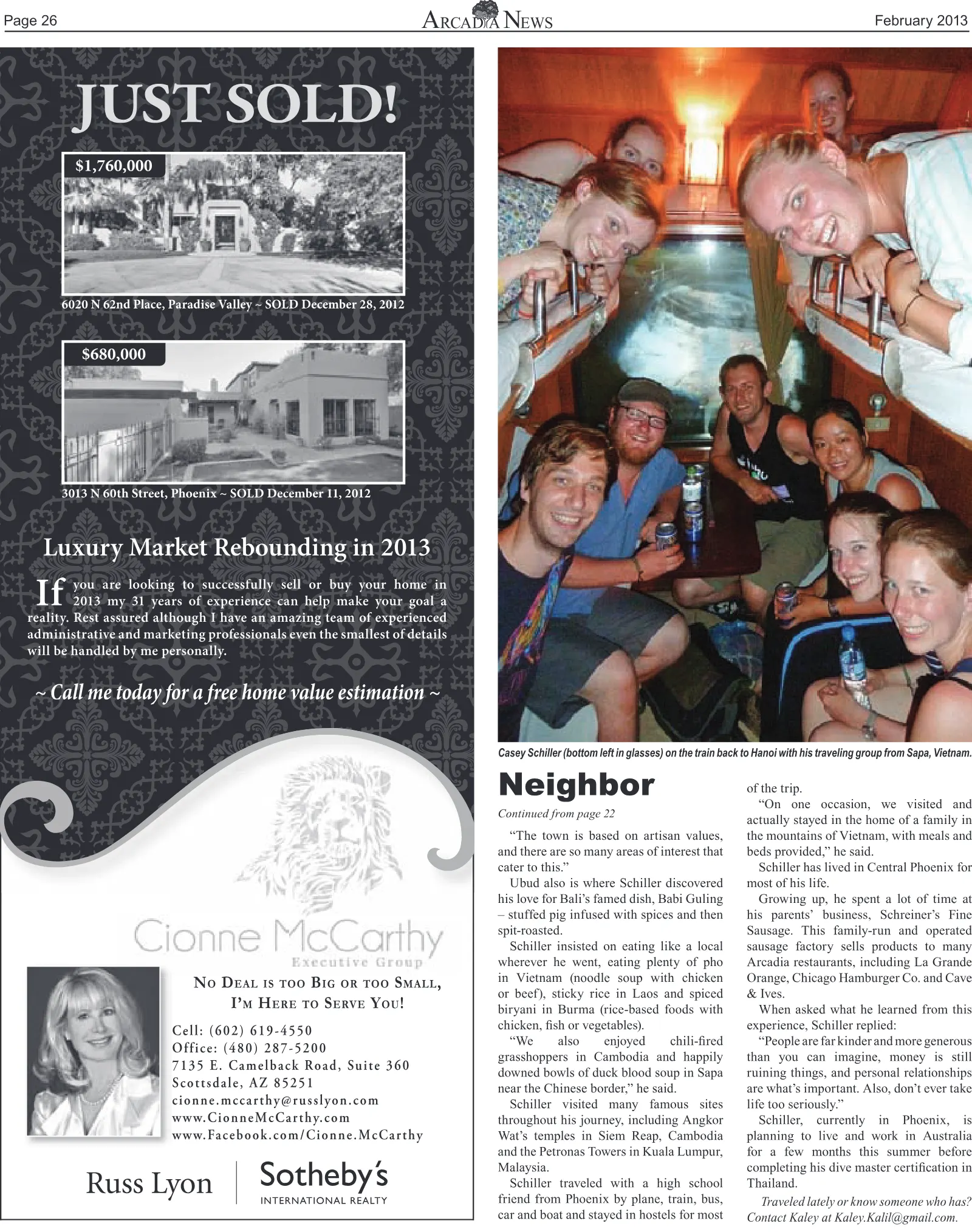
Page 26 February 2013 “The town is based on artisan values, and there are so many areas of interest that cater to this.” Ubud also is where Schiller discovered his love for Bali’s famed dish, Babi Guling – stuffed pig infused with spices and then spit-roasted. Schiller insisted on eating like a local wherever he went, eating plenty of pho in Vietnam (noodle soup with chicken or beef), sticky rice in Laos and spiced biryani in Burma (rice-based foods with chicken, fi sh or vegetables). “We also enjoyed chili- fi red grasshoppers in Cambodia and happily downed bowls of duck blood soup in Sapa near the Chinese border,” he said. Schiller visited many famous sites throughout his journey, including Angkor Wat’s temples in Siem Reap, Cambodia and the Petronas Towers in Kuala Lumpur, Malaysia. Schiller traveled with a high school friend from Phoenix by plane, train, bus, car and boat and stayed in hostels for most of the trip. “On one occasion, we visited and actually stayed in the home of a family in the mountains of Vietnam, with meals and beds provided,” he said. Schiller has lived in Central Phoenix for most of his life. Growing up, he spent a lot of time at his parents’ business, Schreiner’s Fine Sausage. This family-run and operated sausage factory sells products to many Arcadia restaurants, including La Grande Orange, Chicago Hamburger Co. and Cave & Ives. When asked what he learned from this experience, Schiller replied: “People are far kinder and more generous than you can imagine, money is still ruining things, and personal relationships are what’s important. Also, don’t ever take life too seriously.” Schiller, currently in Phoenix, is planning to live and work in Australia for a few months this summer before completing his dive master certi fi cation in Thailand. Traveled lately or know someone who has? Contact Kaley at Kaley.Kalil@gmail.com. Casey Schiller (bottom left in glasses) on the train back to Hanoi with his traveling group from Sapa, Vietnam. Neighbor Continued from page 22 C e l l : ( 6 0 2 ) 6 1 9 - 4 5 5 0 O f f i c e : ( 4 8 0 ) 2 8 7 - 5 2 0 0 7 1 3 5 E . C a m e l b a c k R o a d , Su i t e 3 6 0 S c o t t s d a l e , A Z 8 5 2 5 1 c i o n n e . m c c a r t h y @ r u s s l y o n . c o m w w w. C i o n n e M c C a r t h y. c o m w w w. Fa c e b o o k . c o m / C i o n n e . M c C a r t h y Luxury Market Rebounding in 2013 If you are looking to successfully sell or buy your home in 2013 my 31 years of experience can help make your goal a reality. Rest assured although I have an amazing team of experienced administrative and marketing professionals even the smallest of details will be handled by me personally. ~ Call me today for a free home value estimation ~ NO DEAL IS TOO BIG OR TOO SMALL, I’M HERE TO SERVE YOU! JUST SOLD! $1,760,000 6020 N 62nd Place, Paradise Valley ~ SOLD December 28, 2012 $680,000 3013 N 60th Street, Phoenix ~ SOLD December 11, 2012
Page 27 February 2013 Illness need not eliminate personal relationships By Alison Bailin Batz Roses are Red Violets are Blue Fighting Cancer is Hard Even with a Love Like You Each February, it seems as though the world sees red … in a good way. “But, whether single or in a relationship, this day can be tough – even tougher for those fi ghting illnesses, like cancer,” said Dr. Murali Murty of Arizona Breast Cancer Specialists in Scottsdale. “While those we love are busy fi ghting serious diseases, things like intimacy can fall by the wayside, both physical and emotional.” Here is a look at three key areas of “love” and recommendations on how to deal with matters of the heart if either fi ghting illness – or loving someone who is. Sex Serious diseases such as cancer and diabetes can make the physical act of having sex dif fi cult or impossible. This is especially true among those fi ghting a disease focused in or near a sex organ such as ovarian, testicular and gynological cancers. Simply put, some diseases make the act of intercourse impossible. Diabetes can impact both sexes in a similar way, sometimes restricting blood fl ow to the point of erectile dysfunction or loss of lubrication. And, breast cancer patients can lose a great deal of sensation in their chests, a pleasure center for many women, making the act of sex less appealing or less satisfying. So, does a couple’s sex life simply end while one is fi ghting disease? Absolutely not. The key during this sensitive time is understanding and communication. “The patient must make the effort to communicate their loss of libido or ability to maintain arousal, while the partner must communicate their continued desire for the person has not waned during illness,” Murty said. “Then, both partners must understand that sex as they both know it will need to change, at least temporarily.” Sexuality Certainly, the physical act of sex can be dif fi cult enough during illness. But, it can be the desire to have sex that wanes, often due to a complete loss of sexuality from weight gain, scaring, hormones, et al. During a cancer battle, for example, emotions are running high – and self perceptions can run dangerously low. Murty said while in the acute phase, some of the most common side effects that drain sexuality are: weight gain or loss, depression, pain, anxiety, fatigue, altered sex organs and/or altered sense of self . While there is no magic mojo pill to help, there are support systems ready and waiting to talk to the patient and the partner, who can also lose his/her sense of sexuality while tending to patient needs and becoming the primary caregiver. While the patient’s doctor should have a handy list of recommendations, the Wellness Community (www.twccaz.org) has resources in a group setting. And, one- on-one and/or couples counseling can be critical at this time. Intimacy From kissing to the sharing inside jokes or fears, intimacy is at the core of all relationships. It includes all of the physicality of sex and emotions of sexuality. “The loss of this crucial element in a relationship often means the eventual loss of the relationship itself,” Murty said. But, keeping intimacy alive during illness is hardly a walk in the park. It means the patient has to share fears about the future and health rather than going through the motions of everyday life. It also means the partner must share frustrations and fears as well. It means sweating the small stuff together – often. Loved ones deserve to be a part of the process of disease: The good, the bad and the ugly. Sticking with chocolate better for dental health By Michelle Milan Heart-shaped chocolates and candies. Candlelit dinners with wine, champagne and sweets. Valentine’s Day is full of romance, but may not be so sweet on teeth. Some candies and drinks are safer than others when it comes to healthy teeth. “Candy and sugar is a source for bacteria and a fuel that eats the tooth,” said Dr. Viray Patel from Arcadia Dental Group. “If it’s eaten and not rinsed out, that begins the process of a cavity.” The most damage comes if plaque stays in the mouth for 24 hours, said Dr. Stephen Conrad from Dr. Stephen J. Conrad, Phoenix Cosmetic & Implant Family Dentistry. It will build up and become more invasive. “A colony of bacteria is like mold and you have to break it up,” Conrad said. Most importantly, hard candy has a tendency to stick to teeth especially to the little bumps and ridges, he said. This creates more opportunity for plaque, tartar, dental decay and gum disease. The long-term buildup of hard tartar needs to be removed by a dentist or dental Continued on page 29 The recent recession has left many American families struggling to maintain their lifestyle and save for the future, according to a recent survey by the Consumer Federation of America (CFA) and Certified Financial Planner Board of Standards, Inc. (CFP Board). At the same time, the survey shows that those who have prepared a personal financial plan feel more confident and optimistic, and report more success than those who have not. Would a financial plan help you feel better?