
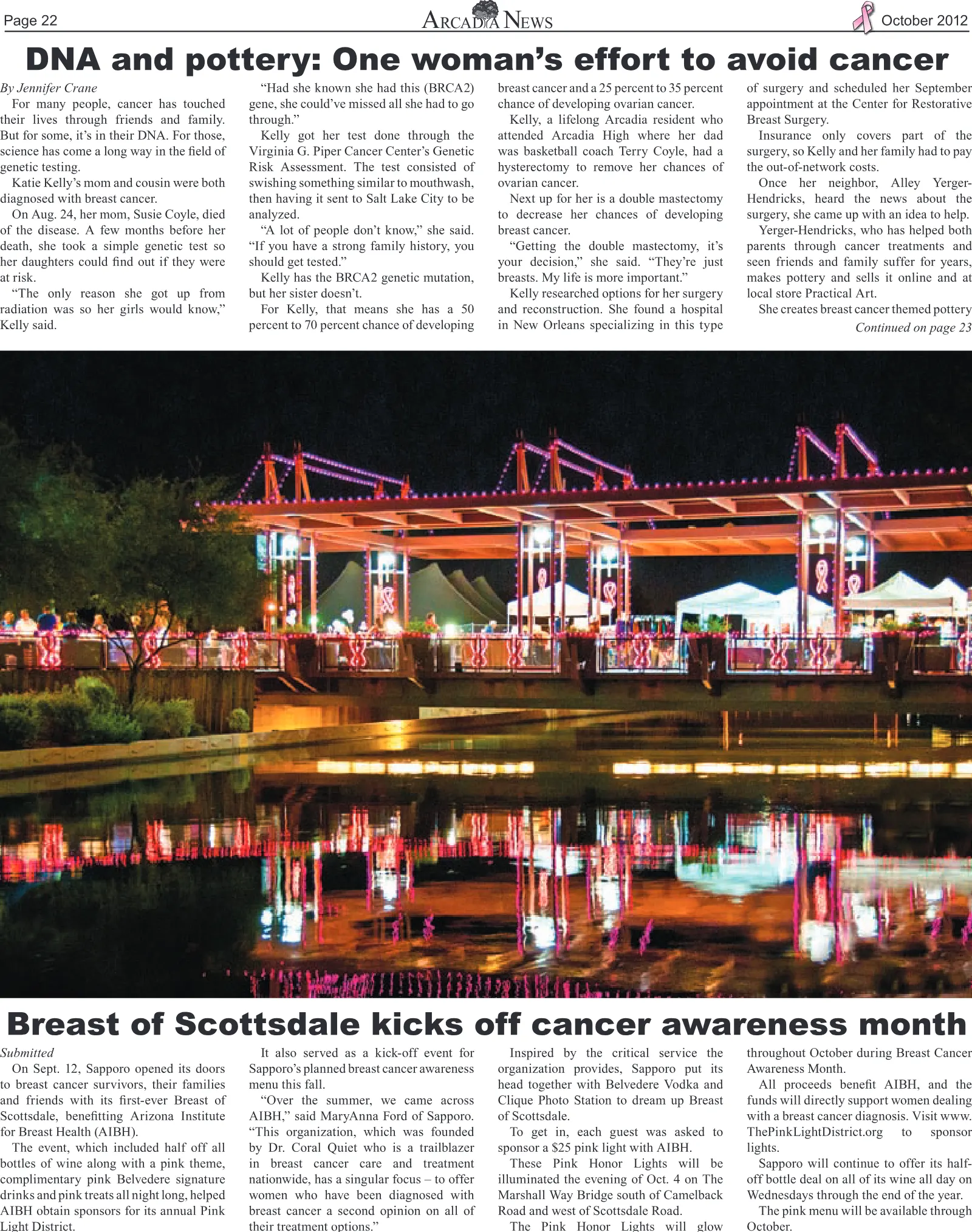
Page 22 October 2012 Breast of Scottsdale kicks off cancer awareness month Submitted On Sept. 12, Sapporo opened its doors to breast cancer survivors, their families and friends with its fi rst-ever Breast of Scottsdale, bene fi tting Arizona Institute for Breast Health (AIBH). The event, which included half off all bottles of wine along with a pink theme, complimentary pink Belvedere signature drinks and pink treats all night long, helped AIBH obtain sponsors for its annual Pink Light District. It also served as a kick-off event for Sapporo’s planned breast cancer awareness menu this fall. “Over the summer, we came across AIBH,” said MaryAnna Ford of Sapporo. “This organization, which was founded by Dr. Coral Quiet who is a trailblazer in breast cancer care and treatment nationwide, has a singular focus – to offer women who have been diagnosed with breast cancer a second opinion on all of their treatment options.” Inspired by the critical service the organization provides, Sapporo put its head together with Belvedere Vodka and Clique Photo Station to dream up Breast of Scottsdale. To get in, each guest was asked to sponsor a $25 pink light with AIBH. These Pink Honor Lights will be illuminated the evening of Oct. 4 on The Marshall Way Bridge south of Camelback Road and west of Scottsdale Road. The Pink Honor Lights will glow throughout October during Breast Cancer Awareness Month. All proceeds bene fi t AIBH, and the funds will directly support women dealing with a breast cancer diagnosis. Visit www. ThePinkLightDistrict.org to sponsor lights. Sapporo will continue to offer its half- off bottle deal on all of its wine all day on Wednesdays through the end of the year. The pink menu will be available through October. DNA and pottery: One woman’s effort to avoid cancer By Jennifer Crane For many people, cancer has touched their lives through friends and family. But for some, it’s in their DNA. For those, science has come a long way in the fi eld of genetic testing. Katie Kelly’s mom and cousin were both diagnosed with breast cancer. On Aug. 24, her mom, Susie Coyle, died of the disease. A few months before her death, she took a simple genetic test so her daughters could fi nd out if they were at risk. “The only reason she got up from radiation was so her girls would know,” Kelly said. “Had she known she had this (BRCA2) gene, she could’ve missed all she had to go through.” Kelly got her test done through the Virginia G. Piper Cancer Center’s Genetic Risk Assessment. The test consisted of swishing something similar to mouthwash, then having it sent to Salt Lake City to be analyzed. “A lot of people don’t know,” she said. “If you have a strong family history, you should get tested.” Kelly has the BRCA2 genetic mutation, but her sister doesn’t. For Kelly, that means she has a 50 percent to 70 percent chance of developing breast cancer and a 25 percent to 35 percent chance of developing ovarian cancer. Kelly, a lifelong Arcadia resident who attended Arcadia High where her dad was basketball coach Terry Coyle, had a hysterectomy to remove her chances of ovarian cancer. Next up for her is a double mastectomy to decrease her chances of developing breast cancer. “Getting the double mastectomy, it’s your decision,” she said. “They’re just breasts. My life is more important.” Kelly researched options for her surgery and reconstruction. She found a hospital in New Orleans specializing in this type of surgery and scheduled her September appointment at the Center for Restorative Breast Surgery. Insurance only covers part of the surgery, so Kelly and her family had to pay the out-of-network costs. Once her neighbor, Alley Yerger- Hendricks, heard the news about the surgery, she came up with an idea to help. Yerger-Hendricks, who has helped both parents through cancer treatments and seen friends and family suffer for years, makes pottery and sells it online and at local store Practical Art. She creates breast cancer themed pottery Continued on page 23 p b
Page 23 October 2012 DNA Continued from page 22 and will custom make pots for people who want to honor loved ones. She also creates seed ribbons with pink Forget-Me-Not seeds to plant in the pots. Proceeds from her cancer-themed pottery will bene fi t Kelly’s treatment costs. “What are we going to do after it’s paid for? Help another woman get tested,” Yerger- Hendricks said. K e l l y and Yerger- H e n d r i c k s became friends during the past year as neighbors with children who play together. Yerger- Hendricks said she admired Kelly’s strength and bravery. “They chose to not play the odds and made this dif fi cult decision,” she said. “They focused on family. Her body and outward appearance don’t de fi ne her. “She’s a great hero for women and for her young daughter.” Kelly left for New Orleans in the middle of September. “I’m ready for this to be over so I can move on with my life,” she said. To purchase the pottery and seed ribbons, visit www.etsy.com/shop/rootsfarm. Advances increase treatment options By Alison Bailin Batz More than 4,000 women in Arizona will be diagnosed with breast cancer this year. And with technology making strides every day, there are ever-increasing numbers of treatment options. Scottsdale radiation oncologist Dr. Robert Kuske said there still are three main categories into which all of the many treatment options fall: surgery, drug therapy and radiation therapy. Different types of operations may be used for breast cancer. A given patient will have some but not all of these surgeries. Lumpectomy: Removal of the cancerous lump only, also known as partial mastectomy. Mastectomy: Complete breast removal. Sentinel lymph node surgery or axillary dissection: Removal of one or more lymph nodes from the armpit area. Breast reconstruction: Plastic surgery to re-create a breast after mastectomy. Drug therapy is the blanket term for drugs used to eliminate cancer from the body. Drugs travel throughout the body and eliminate cancer that cannot be seen or removed by surgery and radiation. Among the most common drug therapies are: Estrogen-blocking drugs , which can be effective against breast cancers stimulated by estrogen, a female hormone. Most are taken as a pill. Chemotherapy drugs , many of which are synthetic versions of plant and animal toxins. Chemotherapy is given for several months, and the drugs may be given by vein or in pill form. Targeted or biologic therapy , which attack speci fi c proteins present in some breast cancers. These drugs may be given with chemotherapy or as stand-alone treatment. Radiation therapy is a type of focused energy. Radiation therapy is useful because cancers are much more vulnerable to radiation than healthy tissues. Kuske, who was one of the fi rst doctors to note the potential for harming the heart when treating left breast cancers, and one of the fi rst to implement methods to minimize risk, said radiation is safest when given in many small treatments over one or more weeks. Today, many women are able to choose radiation because the survival rate for such treatment is the same as with mastectomy for select early stage breast cancers and it allows the patient to preserve her breast. “External beam radiation therapy, the common treatment today for early- stage breast cancer, is safe and very effective,” Kuske said. “But, it can take six time/energy-consuming weeks of daily treatment with side effects.” So Kuske and his team did something about it. While serving as chairman of radiation oncology at the famed Ochsner Clinic in New Orleans, Kuske and colleagues found that, in many cases, less than the whole breast needed radiation. Based on this research, Kuske pioneered Accelerated Partial Breast Irradiation (APBI), a fi ve- day radiation therapy alternative for women with early stage breast cancer. As his research progressed, Kuske found almost all of his cancer patients were strictly those with breast cancer. So, when he moved to Scottsdale in the mid-2000s, Kuske partnered with fellow Scottsdale breast cancer innovator Dr. Coral Quiet and founded Arizona Breast Cancer Specialists, the fi rst center worldwide dedicated to exclusively treating women with breast cancer with radiation. With his focus strictly on treating breast cancer, he has been more determined than ever to move his APBI research into the mainstream. As such, in our own Arcadia backyard, today he is co-principal investigator in the largest breast cancer radiation trial in medical history. His trial, sponsored by the National Cancer Institute, is testing 4,300 women with head-to-head, six-week whole breast radiation versus his fi ve-day APBI. “I am within months of fi nishing the trial, and believe the results will cause the biggest paradigm shift in how patients will be treated since Marie Curie herself discovered radium in 1896, which led to radiation treatment,” Kuske said. For more information go online: BreastMD.com. Visit us and see the many ways we can care for your family. Dr. Rob Mirabelli and Dr. Jen Mirabelli Board Certified Pediatric Dentist Board Certified Orthodontist i PEDIATRIC DENTISTRY & OR THODONTICS www.camelbackpedoortho.com 44th Street & Camelback Road 602-595-3531 NMLS# 259199 / BK0902429 / NOVA NMLS# 3087 JASON WOJTYNA “Your Local Arcadia Lender” Call 602.568.8221 IS THE TIME TO REFI! 30-year fixed rates in the 3’s 15-year fixed rates in the 2’s www.NovaHomeLoans.com/Jason.Wojtyna