

In today's challenging real estate market, selecting the right real estate agent is crucial. It can make all the difference in the world. Whether you're planning on buying, selling, leasing or you just have a question, feel Šee to call Tommy Atkinson. visit Tommy Atkinson .com Free MLS Access • Complete list of ALL Hopi properties for sale Complete List of ALL Tavan properties for sale • Complete list of ALL Arcadia foreclosures Tommy Atkinson 602-625-6020 2011 Tavan School District Sales Results (1/1/2011 – 9/30/2011) Active Homes 90 Homes Homes Sold 146 homes Average Sale Price- $270,517 Average Sold $ Per SF- $126 Average Days On Market- 104 days There is currently 7 months of home inventory ( based on 2010 sales results) 2011 home sales have increased 25% this year. (based on 2010 sales results) Home prices have decreased 8% this year. (based on 2010 sales results) $ Per Square Foot prices have decreased 11% this year. (based on 2010 sales results) Homes are taking 25% less time to sell this year ( Based on 2010 sales results) 2010 Tavan School District Year End Sales Results Results Homes Sold - 145 Homes Homes Sold - 145 Homes Average Sale Price - $294,278 Average Sale Price - $294,278 Average Sold $ Per SF - $142 Average Sold $ Per SF - $142 Average Days On Market - 140 Days Average Days On Market - 140 Days 2009 Tavan School District Year End Sales Results Homes Sold - 135 Homes Average Sale Price - $321,858 Average Sold $ Per SF - $154 Average Days On Market - 129 Days 2008 Tavan School District Year End Sales Results Homes Sold - 107 Homes Average Sale Price - $412,687 Average Sold $ Per SF - $203 Average Days On Market - 140 Days 2007 Tavan School District Year End Sales Results Results Homes Sold - 147 Homes Homes Average Sale Price - $486, $486,045 045 Average Sold $ Per SF - $238 Average Sold $ Per SF - $238 Average Days On Market - 113 D Average Days On Market - 113 Days ays 2011 Hopi School District Sales Results (1/1/2011 – 9/30/2011) Active Homes 121 Homes Homes Sold 189 Homes Average Sale Price $602,338 Average Sold $ Per SF $193 Average Days On Market 126 days There is currently 7 months of home inventory ( based on 2010 sales results) 2011 home sales have increased 20% this year. (based on 2010 sales results) Home prices have decreased 10% this year. (based on 2010 sales results) $ Per Square Foot prices have decreased 3% this year. (based on 2010 sales results) Homes are taking 19% less time to sell this year ( Based on 2010 sales results) 2010 Hopi School District Year End Sales Results Homes Sold - 202 Homes Average Sale Price - $670,142 Average Sold $ Per SF - $200 Average Days On Market - 156 Days 2009 Hopi School District Year End Sales Results Homes Sold - 140 Homes Average Sale Price - $754,006 Average Sold $ Per SF - $239 Average Days On Market - 185 Days 2008 Hopi School District Year End Sales Results Homes Sold - 121 Homes Average Sale Price - $1,002,622 Average Sold $ Per SF - $307 Average Days On Market - 133 Days 2007 Hopi School District Year End Sales Results Homes Sold - 151 Homes Average Sale Price - $1,079,446 Average Sold $ Per SF - $361 Average Days On Market - 131 Days In tod In tod n tod In In to d o n selectin selectin selectin l ti l ti selectin t t e n c t s e It can It can It It can It It It n a I n c a Wheth W Wheth heth Wheth Wh h Wh Wheth Wheth Wheth Whet Wheth h h h e W h h t W h lea l l lea l lea e e l fe f fe f f f f f f AƊźŸŻƀŸ RżŸƄ EƌƍŸƍż SƍŸƍƌ
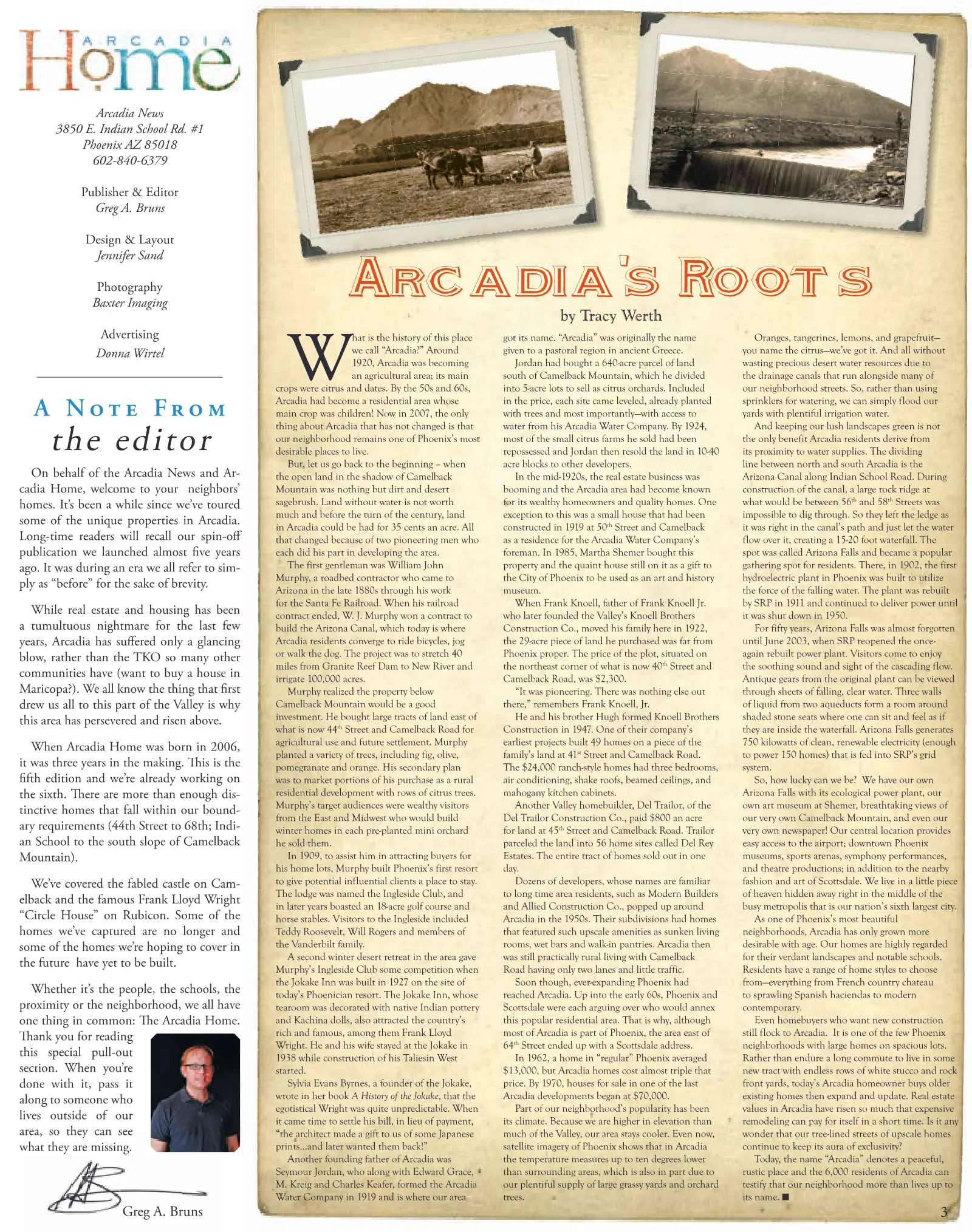
On behalf of the Arcadia News and Ar- cadia Home, welcome to your neighbors’ homes. It’s been a while since we’ve toured some of the unique properties in Arcadia. Long-time readers will recall our spin-off publication we launched almost five years ago. It was during an era we all refer to sim- ply as “before” for the sake of brevity. While real estate and housing has been a tumultuous nightmare for the last few years, Arcadia has suffered only a glancing blow, rather than the TKO so many other communities have (want to buy a house in Maricopa?). We all know the thing that first drew us all to this part of the Valley is why this area has persevered and risen above. When Arcadia Home was born in 2006, it was three years in the making. This is the fifth edition and we’re already working on the sixth. There are more than enough dis- tinctive homes that fall within our bound- ary requirements (44th Street to 68th; Indi- an School to the south slope of Camelback Mountain). We’ve covered the fabled castle on Cam- elback and the famous Frank Lloyd Wright “Circle House” on Rubicon. Some of the homes we’ve captured are no longer and some of the homes we’re hoping to cover in the future have yet to be built. Whether it’s the people, the schools, the proximity or the neighborhood, we all have one thing in common: The Arcadia Home. Thank you for reading this special pull-out section. When you’re done with it, pass it along to someone who lives outside of our area, so they can see what they are missing. Arcadia News 3850 E. Indian School Rd. #1 Phoenix AZ 85018 602-840-6379 Publisher & Editor Greg A. Bruns Design & Layout Jennifer Sand Photography Baxter Imaging Advertising Donna Wirtel A N o t e F r o m the editor W hat is the history of this place we call “Arcadia?” Around 1920, Arcadia was becoming an agricultural area; its main crops were citrus and dates. By the 50s and 60s, Arcadia had become a residential area whose main crop was children! Now in 2007, the only thing about Arcadia that has not changed is that our neighborhood remains one of Phoenix’s most desirable places to live. But, let us go back to the beginning – when the open land in the shadow of Camelback Mountain was nothing but dirt and desert sagebrush. Land without water is not worth much and before the turn of the century, land in Arcadia could be had for 35 cents an acre. All that changed because of two pioneering men who each did his part in developing the area. The first gentleman was William John Murphy, a roadbed contractor who came to Arizona in the late 1880s through his work for the Santa Fe Railroad. When his railroad contract ended, W. J. Murphy won a contract to build the Arizona Canal, which today is where Arcadia residents converge to ride bicycles, jog or walk the dog. The project was to stretch 40 miles from Granite Reef Dam to New River and irrigate 100,000 acres. Murphy realized the property below Camelback Mountain would be a good investment. He bought large tracts of land east of what is now 44 th Street and Camelback Road for agricultural use and future settlement. Murphy planted a variety of trees, including fig, olive, pomegranate and orange. His secondary plan was to market portions of his purchase as a rural residential development with rows of citrus trees. Murphy’s target audiences were wealthy visitors from the East and Midwest who would build winter homes in each pre-planted mini orchard he sold them. In 1909, to assist him in attracting buyers for his home lots, Murphy built Phoenix’s first resort to give potential influential clients a place to stay. The lodge was named the Ingleside Club, and in later years boasted an 18-acre golf course and horse stables. Visitors to the Ingleside included Teddy Roosevelt, Will Rogers and members of the Vanderbilt family. A second winter desert retreat in the area gave Murphy’s Ingleside Club some competition when the Jokake Inn was built in 1927 on the site of today’s Phoenician resort. The Jokake Inn, whose tearoom was decorated with native Indian pottery and Kachina dolls, also attracted the country’s rich and famous, among them Frank Lloyd Wright. He and his wife stayed at the Jokake in 1938 while construction of his Taliesin West started. Sylvia Evans Byrnes, a founder of the Jokake, wrote in her book A History of the Jokake , that the egotistical Wright was quite unpredictable. When it came time to settle his bill, in lieu of payment, “the architect made a gift to us of some Japanese prints...and later wanted them back!” Another founding father of Arcadia was Seymour Jordan, who along with Edward Grace, M. Kreig and Charles Keafer, formed the Arcadia Water Company in 1919 and is where our area got its name. “Arcadia” was originally the name given to a pastoral region in ancient Greece. Jordan had bought a 640-acre parcel of land south of Camelback Mountain, which he divided into 5-acre lots to sell as citrus orchards. Included in the price, each site came leveled, already planted with trees and most importantly—with access to water from his Arcadia Water Company. By 1924, most of the small citrus farms he sold had been repossessed and Jordan then resold the land in 10-40 acre blocks to other developers. In the mid-1920s, the real estate business was booming and the Arcadia area had become known for its wealthy homeowners and quality homes. One exception to this was a small house that had been constructed in 1919 at 50 th Street and Camelback as a residence for the Arcadia Water Company’s foreman. In 1985, Martha Shemer bought this property and the quaint house still on it as a gift to the City of Phoenix to be used as an art and history museum. When Frank Knoell, father of Frank Knoell Jr. who later founded the Valley’s Knoell Brothers Construction Co., moved his family here in 1922, the 29-acre piece of land he purchased was far from Phoenix proper. The price of the plot, situated on the northeast corner of what is now 40 th Street and Camelback Road, was $2,300. “It was pioneering. There was nothing else out there,” remembers Frank Knoell, Jr. He and his brother Hugh formed Knoell Brothers Construction in 1947. One of their company’s earliest projects built 49 homes on a piece of the family’s land at 41 st Street and Camelback Road. The $24,000 ranch-style homes had three bedrooms, air conditioning, shake roofs, beamed ceilings, and mahogany kitchen cabinets. Another Valley homebuilder, Del Trailor, of the Del Trailor Construction Co., paid $800 an acre for land at 45 th Street and Camelback Road. Trailor parceled the land into 56 home sites called Del Rey Estates. The entire tract of homes sold out in one day. Dozens of developers, whose names are familiar to long time area residents, such as Modern Builders and Allied Construction Co., popped up around Arcadia in the 1950s. Their subdivisions had homes that featured such upscale amenities as sunken living rooms, wet bars and walk-in pantries. Arcadia then was still practically rural living with Camelback Road having only two lanes and little traffic. Soon though, ever-expanding Phoenix had reached Arcadia. Up into the early 60s, Phoenix and Scottsdale were each arguing over who would annex this popular residential area. That is why, although most of Arcadia is part of Phoenix, the area east of 64 th Street ended up with a Scottsdale address. In 1962, a home in “regular” Phoenix averaged $13,000, but Arcadia homes cost almost triple that price. By 1970, houses for sale in one of the last Arcadia developments began at $70,000. Part of our neighborhood’s popularity has been its climate. Because we are higher in elevation than much of the Valley, our area stays cooler. Even now, satellite imagery of Phoenix shows that in Arcadia the temperature measures up to ten degrees lower than surrounding areas, which is also in part due to our plentiful supply of large grassy yards and orchard trees. Oranges, tangerines, lemons, and grapefruit— you name the citrus—we’ve got it. And all without wasting precious desert water resources due to the drainage canals that run alongside many of our neighborhood streets. So, rather than using sprinklers for watering, we can simply flood our yards with plentiful irrigation water. And keeping our lush landscapes green is not the only benefit Arcadia residents derive from its proximity to water supplies. The dividing line between north and south Arcadia is the Arizona Canal along Indian School Road. During construction of the canal, a large rock ridge at what would be between 56 th and 58 th Streets was impossible to dig through. So they left the ledge as it was right in the canal’s path and just let the water flow over it, creating a 15-20 foot waterfall. The spot was called Arizona Falls and became a popular gathering spot for residents. There, in 1902, the first hydroelectric plant in Phoenix was built to utilize the force of the falling water. The plant was rebuilt by SRP in 1911 and continued to deliver power until it was shut down in 1950. For fifty years, Arizona Falls was almost forgotten until June 2003, when SRP reopened the once- again rebuilt power plant. Visitors come to enjoy the soothing sound and sight of the cascading flow. Antique gears from the original plant can be viewed through sheets of falling, clear water. Three walls of liquid from two aqueducts form a room around shaded stone seats where one can sit and feel as if they are inside the waterfall. Arizona Falls generates 750 kilowatts of clean, renewable electricity (enough to power 150 homes) that is fed into SRP’s grid system. So, how lucky can we be? We have our own Arizona Falls with its ecological power plant, our own art museum at Shemer, breathtaking views of our very own Camelback Mountain, and even our very own newspaper! Our central location provides easy access to the airport; downtown Phoenix museums, sports arenas, symphony performances, and theatre productions; in addition to the nearby fashion and art of Scottsdale. We live in a little piece of heaven hidden away right in the middle of the busy metropolis that is our nation’s sixth largest city. As one of Phoenix’s most beautiful neighborhoods, Arcadia has only grown more desirable with age. Our homes are highly regarded for their verdant landscapes and notable schools. Residents have a range of home styles to choose from—everything from French country chateau to sprawling Spanish haciendas to modern contemporary. Even homebuyers who want new construction still flock to Arcadia. It is one of the few Phoenix neighborhoods with large homes on spacious lots. Rather than endure a long commute to live in some new tract with endless rows of white stucco and rock front yards, today’s Arcadia homeowner buys older existing homes then expand and update. Real estate values in Arcadia have risen so much that expensive remodeling can pay for itself in a short time. Is it any wonder that our tree-lined streets of upscale homes continue to keep its aura of exclusivity? Today, the name “Arcadia” denotes a peaceful, rustic place and the 6,000 residents of Arcadia can testify that our neighborhood more than lives up to its name. by Tracy Werth Arcadia’s Roots area, so they can see what they are missing. Greg A. Bruns 3